



Je cadeautjes zeker op tijd in huis hebben voor de feestdagen? Kom langs in onze winkels en vind het perfecte geschenk!
- Afhalen na 1 uur in een winkel met voorraad
- Gratis thuislevering in België vanaf € 30
- Ruim aanbod met 7 miljoen producten
Je cadeautjes zeker op tijd in huis hebben voor de feestdagen? Kom langs in onze winkels en vind het perfecte geschenk!
- Afhalen na 1 uur in een winkel met voorraad
- Gratis thuislevering in België vanaf € 30
- Ruim aanbod met 7 miljoen producten





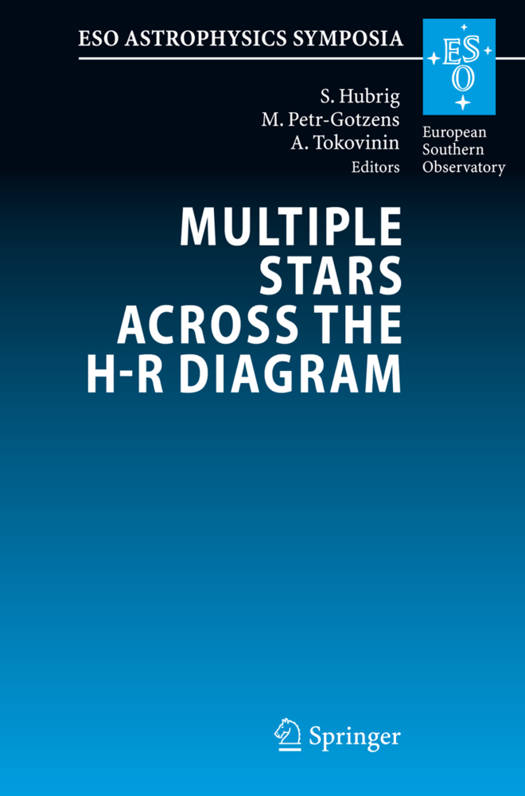
Multiple Stars across the H-R Diagram
Proceedings of the ESO Workshop held in Garching, Germany, 12-15 July 2005
€ 106,95
+ 213 punten
Omschrijving
The ESO workshop "Multiple Stars across the H-R Diagram" was held in Garching on 12-15, July 2005. The topics included observations of multiple stars from ground and space, dynamical and stellar evolution in multiple systems, e?ects of the environment on multiplicity, formation and early e- lution of multiple stars, and special components of multiple stars (chemically peculiar stars, blue stragglers, brown dwarfs, etc.). Stars show a marked tendency to be in systems of di?erent multiplicity, 7 ranging from simple binaries and triples to globular clusters with N?10 . Modern observations give a frequency of binary and multiple stars in the Galactic ?eld of up to 70%, and between 5% and 20% of these systems are at least triple. There is evidence that the degree of multiplicity increases with primary mass. Many known multiple systems are too wide to have s- ni?cant physical interaction between their components. However, tidal and N-body dynamical interactions are important even in relatively wide s- tems and probably lead to the shrinkage of inner orbits. This sets the stage for spectacular evolutionary processes such as Roche-lobe over?ow, me- ers, supernovae, formation of special components, etc. Only recently did we realize that some of these processes require at least three stars. Theformationofmultiplesystemsremainsadi?cultandchallengingpart of astrophysics, although it has been addressed at the Workshop only brie?y.
Specificaties
Betrokkenen
- Uitgeverij:
Inhoud
- Aantal bladzijden:
- 305
- Taal:
- Engels
- Reeks:
Eigenschappen
- Productcode (EAN):
- 9783642094224
- Uitvoering:
- Paperback
- Afmetingen:
- 156 mm x 235 mm
- Gewicht:
- 488 g

Alleen bij Standaard Boekhandel
+ 213 punten op je klantenkaart van Standaard Boekhandel
CADEAU


Beoordelingen
We publiceren alleen reviews die voldoen aan de voorwaarden voor reviews. Bekijk onze voorwaarden voor reviews.