



Bedankt voor het vertrouwen het afgelopen jaar! Om jou te bedanken bieden we GRATIS verzending (in België) aan op alles gedurende de hele maand januari.
- Afhalen na 1 uur in een winkel met voorraad
- In januari gratis thuislevering in België
- Ruim aanbod met 7 miljoen producten
Bedankt voor het vertrouwen het afgelopen jaar! Om jou te bedanken bieden we GRATIS verzending (in België) aan op alles gedurende de hele maand januari.
- Afhalen na 1 uur in een winkel met voorraad
- In januari gratis thuislevering in België
- Ruim aanbod met 7 miljoen producten





€ 148,45
+ 296 punten
Omschrijving
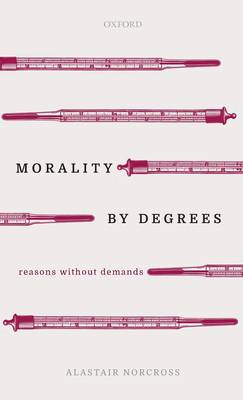
In Morality by Degrees, Alastair Norcross articulates and defends a radical new approach to ethical theory. Consequentialist theories of the right connect the rightness and wrongness (and related notions) of actions with the intrinsic goodness and badness of states of affairs consequential on
those actions. The most popular such theory is maximization, which is said to demand of agents that they maximize the good, that they do the best they can, at all times. Thus it may seem that consequentialist theories are overly demanding, and, relatedly, that they cannot accommodate the phenomenon
of going above and beyond the demands of duty. However, a clear understanding of consequentialism leaves no room for a theory of the right, at least not at the fundamental level of the theory. A consequentialist theory, such as utilitarianism, is a theory of how to rank outcomes, and derivatively
actions, which provides reasons for choosing some actions over others. It is thus a purely scalar theory, with no demands that certain actions be performed, and no fundamental classification of actions as right or wrong. However, such notions may have pragmatic benefits at the level of application,
since many people find it easier to guide their conduct by simple commands, rather than to think in terms of reasons of varying strength to do one thing rather than another. A contextualist semantics for various terms, such as right, permissible, harm, when combined with the scalar approach to
consequentialism, allows for the expression of truth-apt propositions with sentences containing such terms.
those actions. The most popular such theory is maximization, which is said to demand of agents that they maximize the good, that they do the best they can, at all times. Thus it may seem that consequentialist theories are overly demanding, and, relatedly, that they cannot accommodate the phenomenon
of going above and beyond the demands of duty. However, a clear understanding of consequentialism leaves no room for a theory of the right, at least not at the fundamental level of the theory. A consequentialist theory, such as utilitarianism, is a theory of how to rank outcomes, and derivatively
actions, which provides reasons for choosing some actions over others. It is thus a purely scalar theory, with no demands that certain actions be performed, and no fundamental classification of actions as right or wrong. However, such notions may have pragmatic benefits at the level of application,
since many people find it easier to guide their conduct by simple commands, rather than to think in terms of reasons of varying strength to do one thing rather than another. A contextualist semantics for various terms, such as right, permissible, harm, when combined with the scalar approach to
consequentialism, allows for the expression of truth-apt propositions with sentences containing such terms.
Specificaties
Betrokkenen
- Auteur(s):
- Uitgeverij:
Inhoud
- Aantal bladzijden:
- 170
- Taal:
- Engels
Eigenschappen
- Productcode (EAN):
- 9780198844990
- Verschijningsdatum:
- 25/05/2020
- Uitvoering:
- Hardcover
- Formaat:
- Genaaid
- Afmetingen:
- 140 mm x 216 mm
- Gewicht:
- 317 g


Alleen bij Standaard Boekhandel
+ 296 punten op je klantenkaart van Standaard Boekhandel
SOLDEN


Beoordelingen
We publiceren alleen reviews die voldoen aan de voorwaarden voor reviews. Bekijk onze voorwaarden voor reviews.