


- Afhalen na 1 uur in een winkel met voorraad
- Gratis thuislevering in België vanaf € 30
- Ruim aanbod met 7 miljoen producten
- Afhalen na 1 uur in een winkel met voorraad
- Gratis thuislevering in België vanaf € 30
- Ruim aanbod met 7 miljoen producten




€ 23,00
+ 46 punten
Omschrijving
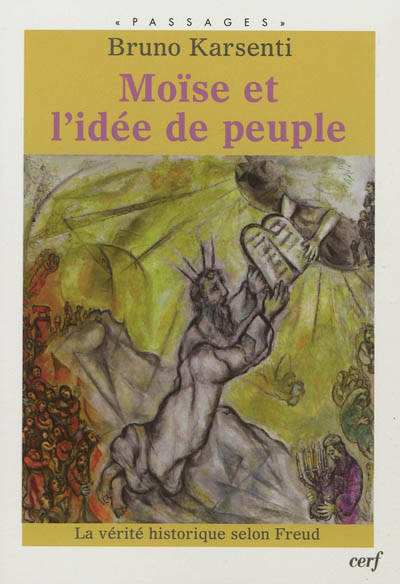
Les juifs sont juifs en Moïse, qui ne l'était pas. Ainsi se résume la proposition scandaleuse de Freud. Scandaleuse pour les juifs sans doute, mais aussi pour la culture occidentale tout entière, où la singularité comme la persistance de ce peuple se donnent toujours comme une énigme. De quoi est faite l'idée de peuple dont nous héritons ? Comment se transforme-t-elle depuis l'irruption monothéiste où interviennent conjointement les trois instances du grand homme, du Dieu unique, et du peuple élu ? Questions qui deviennent plus insistantes encore lorsque les modernes en viennent à se définir, avec Rousseau, à partir de l'« acte par lequel un peuple est un peuple » — non sans admettre que l'art du grand législateur est plus pour eux qu'un ancien souvenir, mais une source dont ils voudraient de nouveau bénéficier à l'heure où ils prétendent se donner à eux-mêmes leurs lois. C'est pourquoi, en dépit de l'incertitude qui plane sur son existence, le législateur mosaïque n'a de cesse de hanter la conscience moderne. En lui se mêlent deux interrogations : comment se constitue l'expérience politique occidentale, et quelle place vient occuper le peuple juif dans cette histoire, sachant qu'elle est évidemment traversée par des lignes culturelles hétérogènes, et marquée décisivement par le christianisme ? Une lecture du dernier livre de Freud permet d'affronter ces deux questions, pour autant que l'on s'efforce d'en restituer la portée politique.
--
Jews are Jewish in Moses, who was not himself a Jew. This is the briefest possible summary of Freud's scandalous proposition. Scandalous to Jews, undoubtedly but also scandalous for Western culture in its ensemble, considering the place it reserves in its history for this particular people whose identity and persistence as a people has been a constant enigma. But what exactly constitutes this notion of people we have inherited? How has it been transformed, since that monotheistic moment when three instances intervened concertedly but in mysterious interaction: a great man, a unique God, and a chosen people? These questions become even more urgent when the moderns define themselves, like Rousseau, on the basis of the ‘act by which a people is a people'. Not without confessing, however, that the art of the great legislator is more than a distant souvenir for them, rather a source they would like to benefit from again, at a time when they take it upon themselves to issue laws unto themselves. That is why, in spite of the incertitude that hovers over his portrait and his existence, Moses the lawmaker still haunts the modern conscience. Two questions blend together in him: How is Western political experience constituted? What is the place of the Jewish people in that history, bearing in mind that it is obviously traversed by heterogeneous cultural lines, and definitively marked by Christianity? Reading Freud's last book should permit us to link these two questions and confront them both, if we make the effort and reaching beyond the analysis of religion as a generic cultural fact, to give it all its political consequence. Born in 1966, Bruno Karsenti is a director of studies at the EHESS. His area of specialization lies on the borderline of political philosophy and social science - sociology and anthropology in particular. His research has focused on Emile Durkheim, Marcel Mauss and Auguste Comte. He has written several essays, including Politique de l'ésprit: Auguste Comte et la naissance de la science sociale (Hermann, 2006) and La Société en personnes. Etudes Durkenheimiennes (Economica, 2006).
--
Jews are Jewish in Moses, who was not himself a Jew. This is the briefest possible summary of Freud's scandalous proposition. Scandalous to Jews, undoubtedly but also scandalous for Western culture in its ensemble, considering the place it reserves in its history for this particular people whose identity and persistence as a people has been a constant enigma. But what exactly constitutes this notion of people we have inherited? How has it been transformed, since that monotheistic moment when three instances intervened concertedly but in mysterious interaction: a great man, a unique God, and a chosen people? These questions become even more urgent when the moderns define themselves, like Rousseau, on the basis of the ‘act by which a people is a people'. Not without confessing, however, that the art of the great legislator is more than a distant souvenir for them, rather a source they would like to benefit from again, at a time when they take it upon themselves to issue laws unto themselves. That is why, in spite of the incertitude that hovers over his portrait and his existence, Moses the lawmaker still haunts the modern conscience. Two questions blend together in him: How is Western political experience constituted? What is the place of the Jewish people in that history, bearing in mind that it is obviously traversed by heterogeneous cultural lines, and definitively marked by Christianity? Reading Freud's last book should permit us to link these two questions and confront them both, if we make the effort and reaching beyond the analysis of religion as a generic cultural fact, to give it all its political consequence. Born in 1966, Bruno Karsenti is a director of studies at the EHESS. His area of specialization lies on the borderline of political philosophy and social science - sociology and anthropology in particular. His research has focused on Emile Durkheim, Marcel Mauss and Auguste Comte. He has written several essays, including Politique de l'ésprit: Auguste Comte et la naissance de la science sociale (Hermann, 2006) and La Société en personnes. Etudes Durkenheimiennes (Economica, 2006).
Specificaties
Betrokkenen
- Auteur(s):
- Uitgeverij:
Inhoud
- Aantal bladzijden:
- 229
- Taal:
- Frans
Eigenschappen
- Productcode (EAN):
- 9782204099318
- Verschijningsdatum:
- 25/10/2012
- Uitvoering:
- Paperback
- Afmetingen:
- 140 mm x 200 mm
- Gewicht:
- 257 g


Alleen bij Standaard Boekhandel
+ 46 punten op je klantenkaart van Standaard Boekhandel
Wedstrijd


Beoordelingen
We publiceren alleen reviews die voldoen aan de voorwaarden voor reviews. Bekijk onze voorwaarden voor reviews.