


- Afhalen na 1 uur in een winkel met voorraad
- Gratis thuislevering in België vanaf € 30
- Ruim aanbod met 7 miljoen producten
- Afhalen na 1 uur in een winkel met voorraad
- Gratis thuislevering in België vanaf € 30
- Ruim aanbod met 7 miljoen producten





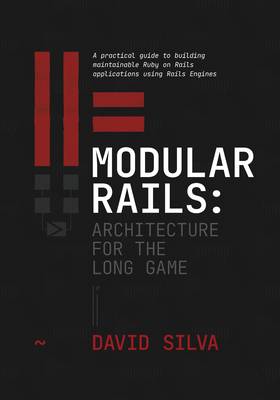
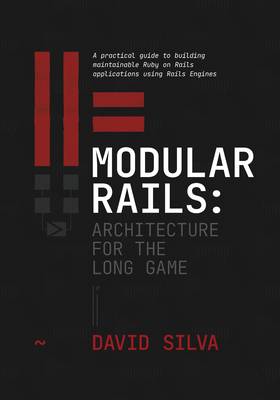
Modular Rails
A practical guide to building maintainable Ruby on Rails applications using Rails Engines
David Silva
Paperback | Engels
€ 80,95
+ 161 punten
Omschrijving
The last comprehensive book on extending Ruby on Rails from the inside was published over a decade ago. Since then, applications have grown from small startups to enormous monoliths, teams have scaled from three developers to fifty, and the codebase that was delightful at 20 models became terrifying at 200.
Meanwhile, Ruby on Rails itself has been shipping the answer since version 3.1: mountable engines with namespace isolation. The same mechanism that powers Devise, Spree, and ActiveAdmin.
This book bridges the gap between software architecture principles and the tools Ruby on Rails already ships. It takes the thinking of Robert C. Martin, Neal Ford, Mark Richards, and Kent Beck and applies it to real Ruby on Rails applications - with working code, honest trade-offs, and a companion open-source application you can run yourself.
What you'll learn:
Who this book is for:
Senior Ruby on Rails developers, tech leads, and engineering managers who have felt the pain of a growing monolith. You should be comfortable building Ruby on Rails applications already - this is not a beginner tutorial. If your team debates microservices vs monolith, if your test suite takes too long, or if new developers take weeks to become productive in your codebase, this book is for you.
What makes this book different:
Every chapter includes working code. A companion open-source application (Orbit) lets you see the patterns in action - clone it, run it, and explore a fully modular Ruby on Rails application yourself. This is not theory in a vacuum. It is architecture applied to the framework you already use, by an engineer who builds and decomposes production Ruby on Rails monoliths for a living.
About the author:
David Silva is a Senior Software Engineer with over 15 years of Ruby experience across fintech, government services, and high-growth platforms serving millions of users. He has spent his career building, maintaining, and decomposing large Ruby on Rails monoliths - and applying the architectural patterns in this book to production systems under real constraints. He is the founder of CarerNotes and the author of Building Your Own Roguelike: A Practical Guide.
Four parts. Eighteen chapters. From principles to practice to the hard questions most architecture books skip.
Specificaties
Betrokkenen
- Auteur(s):
- Uitgeverij:
Inhoud
- Aantal bladzijden:
- 380
- Taal:
- Engels
Eigenschappen
- Productcode (EAN):
- 9781066649402
- Verschijningsdatum:
- 6/05/2026
- Uitvoering:
- Paperback
- Formaat:
- Trade paperback (VS)
- Afmetingen:
- 178 mm x 254 mm
- Gewicht:
- 657 g


Alleen bij Standaard Boekhandel
+ 161 punten op je klantenkaart van Standaard Boekhandel
Cadeau

AANGERADEN


Beoordelingen
We publiceren alleen reviews die voldoen aan de voorwaarden voor reviews. Bekijk onze voorwaarden voor reviews.