


- Afhalen na 1 uur in een winkel met voorraad
- Gratis thuislevering in België vanaf € 30
- Ruim aanbod met 7 miljoen producten
- Afhalen na 1 uur in een winkel met voorraad
- Gratis thuislevering in België vanaf € 30
- Ruim aanbod met 7 miljoen producten





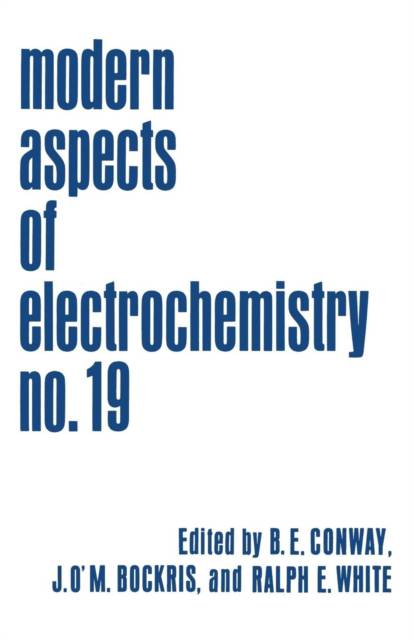
Modern Aspects of Electrochemistry
€ 106,95
+ 213 punten
Omschrijving
The present volume is comprised of six chapters covering topics having both fundamental and substantial applied significance in electrochemistry: ion-exchange membrane behavior, corrosion and metal deposition, semiconductor charge injection, and the electro- catalytic properties of carbon. In the first chapter, Verbrugge and Pintauro examine transport models for ion-exchange membranes using approaches from the direction of electrochemical thermodynamics of irreversible proces- ses and others. The properties ofth models are examined quantita- tively in some mathematical detail. Drazic, in Chapter 2, gives an up-to-date account of advances in our knowledge of the "active" dissolution of iron in corrosion processes and the accompanying processes of H2 evolution and H sorption. The important process of O reduction in iron corrosion 2 is also considered, together with the more controllable aspect of anodic dissolution and cathodic deposition, as well as the influence of anions on the dissolution kinetics of iron in aqueous medium. An important aspect of metal plating technology is the use of a modulated or pulsed-current regime to provide better control over deposit morphology. In two chapters, one by Popov and Mak- simovic and the other by Pesco and Cheh, complementary aspects of this important technique are examined in detail: from the theo- retical electrode-kinetic direction, taking into account the important nonsteady diffusion situation, and from the practical direction of examining the morphologies of electrodeposits generated under various AC modulated or pulsed-current regimes.
Specificaties
Betrokkenen
- Uitgeverij:
Inhoud
- Aantal bladzijden:
- 414
- Taal:
- Engels
- Reeks:
- Reeksnummer:
- nr. 19
Eigenschappen
- Productcode (EAN):
- 9781468486698
- Verschijningsdatum:
- 6/05/2012
- Uitvoering:
- Paperback
- Formaat:
- Trade paperback (VS)
- Afmetingen:
- 140 mm x 216 mm
- Gewicht:
- 480 g

Alleen bij Standaard Boekhandel
+ 213 punten op je klantenkaart van Standaard Boekhandel
AANGERADEN


Beoordelingen
We publiceren alleen reviews die voldoen aan de voorwaarden voor reviews. Bekijk onze voorwaarden voor reviews.