


- Afhalen na 1 uur in een winkel met voorraad
- Gratis thuislevering in België vanaf € 30
- Ruim aanbod met 7 miljoen producten
- Afhalen na 1 uur in een winkel met voorraad
- Gratis thuislevering in België vanaf € 30
- Ruim aanbod met 7 miljoen producten





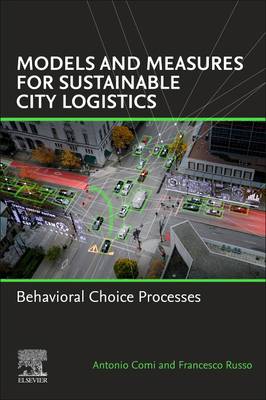
Models and Measures for Sustainable City Logistics
Behavioral Choice Processes
Francesco Russo, Antonio Comi
Paperback | Engels
€ 184,45
+ 368 punten
Omschrijving
Models and Measures for Sustainable City Logistics: Behavioral Choice Processes offers a thorough understanding of urban goods movements, focusing on stakeholders' behavior. It outlines the role of modeling behaviors in determining urban goods movements, mapping the behavioral process of end consumers and retailers. It provides new methods of urban freight transport simulation, considering the challenges of sustainable development goals, and uses the most recent modeling approaches for designing and planning city logistics scenarios. It also outlines the relationships between measures and the main components of sustainable development. This book guides readers in implementing the most effective city logistics measures and actions through the estimation of impacts and system performances. It first specifies end-consumers' behaviors, then formalizes retailers' behaviors. Subsequently, decision-maker patterns and the goods quantities are analyzed. It presents problems whose solutions allow planners to identify various types of urban freight vehicles and subsequent road network flows. It also gives the overall structure of the model system and the specification of each single model. It presents some models calibrated in different real cases, highlighting their transferability to other contexts. It reviews the role of information and communication technologies (ICTs). It presents energy efficiency according to the Sustainable Development Goals of Agenda 2030, evidencing the different roles of the transshipment nodes. Furthermore, it introduces Implementable measures and examines the relationships between measures and the main components of Sustainable Development of Agenda 2030. Transportation technicians (urban transport planners, urban traffic managers and company f leet managers), postgraduate students, and researchers alike will find this to be a valuable resource to understand how to incorporate user behavior into urban freight transport and logistics planning and modeling, ultimately helping them optimize processes and promote sustainability.
Specificaties
Betrokkenen
- Auteur(s):
- Uitgeverij:
Inhoud
- Aantal bladzijden:
- 213
- Taal:
- Engels
Eigenschappen
- Productcode (EAN):
- 9780443331329
- Verschijningsdatum:
- 26/06/2026
- Uitvoering:
- Paperback
- Formaat:
- Trade paperback (VS)
- Afmetingen:
- 152 mm x 229 mm
- Gewicht:
- 449 g


Alleen bij Standaard Boekhandel
+ 368 punten op je klantenkaart van Standaard Boekhandel
Cadeau

AANGERADEN


Beoordelingen
We publiceren alleen reviews die voldoen aan de voorwaarden voor reviews. Bekijk onze voorwaarden voor reviews.