



Bedankt voor het vertrouwen het afgelopen jaar! Om jou te bedanken bieden we GRATIS verzending (in België) aan op alles gedurende de hele maand januari.
- Afhalen na 1 uur in een winkel met voorraad
- In januari gratis thuislevering in België
- Ruim aanbod met 7 miljoen producten
Bedankt voor het vertrouwen het afgelopen jaar! Om jou te bedanken bieden we GRATIS verzending (in België) aan op alles gedurende de hele maand januari.
- Afhalen na 1 uur in een winkel met voorraad
- In januari gratis thuislevering in België
- Ruim aanbod met 7 miljoen producten





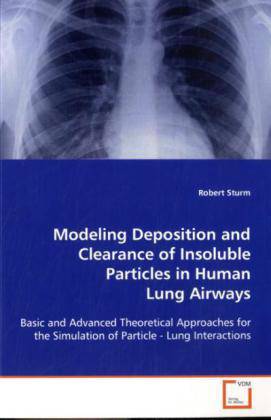
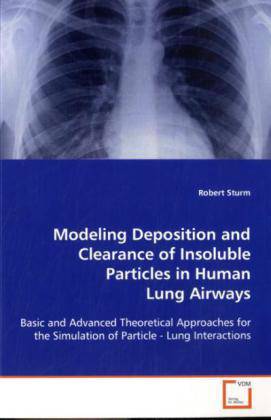
Modeling Deposition and Clearance of Insoluble Particles in Human Lung Airways
Robert Sturm
Paperback | Engels
€ 115,95
+ 231 punten
Omschrijving
Main goal of the work was the development of a complete bronchial clearance model including a fast clearance phase represented by the mucociliary escalator as well as a slow clearance phase which describes long-term clearance mechanisms. The model was applied to healthy lungs and, after some specific modifications, also to lungs of COPD-patients. Beside the extensive modeling of bronchial clearance, major interests were focused on the improvement of the existing stochastic deposition model by a) the development of generation-specific correction factors describing enhanced particle deposition in the proximal airways due to inertial impaction and b) the computation and visualization of spatial deposition patterns, better reflecting the complex behaviour of inhaled particles. Concerning the reliable modeling of bronchial clearance, several approaches were introduced, ranging from the mathematical description of single mechanisms over the stochastic formulation of fast and slow clearance phases to the creation of a multicompartmental model. Independent of the used approach, computed clearance data always corresponded well with available results from various inhalation experiments.
Specificaties
Betrokkenen
- Auteur(s):
- Uitgeverij:
Inhoud
- Aantal bladzijden:
- 364
- Taal:
- Engels
Eigenschappen
- Productcode (EAN):
- 9783639008920
- Verschijningsdatum:
- 22/10/2008
- Uitvoering:
- Paperback
- Formaat:
- Trade paperback (VS)
- Afmetingen:
- 152 mm x 229 mm
- Gewicht:
- 485 g


Alleen bij Standaard Boekhandel
+ 231 punten op je klantenkaart van Standaard Boekhandel
SOLDEN


Beoordelingen
We publiceren alleen reviews die voldoen aan de voorwaarden voor reviews. Bekijk onze voorwaarden voor reviews.