


- Afhalen na 1 uur in een winkel met voorraad
- Gratis thuislevering in België vanaf € 30
- Ruim aanbod met 7 miljoen producten
- Afhalen na 1 uur in een winkel met voorraad
- Gratis thuislevering in België vanaf € 30
- Ruim aanbod met 7 miljoen producten





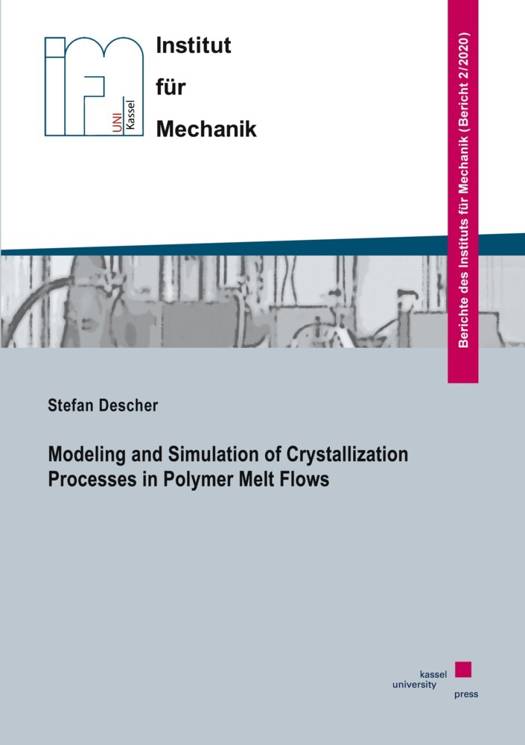
Modeling and Simulation of Crystallization Processes in Polymer Melt Flows
Stefan Descher
€ 38,45
+ 76 punten
Omschrijving
The last stage of many manufacturing processes used in polymer processing industry are primary forming processes such as extrusion or injection molding. If melts of semicrystalline plastics are subjected to such processes, temperature control opens up the possibility of influencing solid state properties. This concerns those that depend on crystallinity, as it is possible to enhance crystallization by slow cooling or to suppress it by quenching. However, during the forming process the melt rarely rests, so that solidification processes in flows occur. Those complex processes can only be examined in detail bynumerical simulation. The present work contributes to this by developing a novel modeling approach for isotactic Polypropylene, detailed presentation and solution of problems in modeling and numerics, as well as exemplary studies for the calculation of a profile extrusion and injection molding process.Detailed calorimetric and rheometric investigations of the solidification behavior and a consideration of molecular processes during crystallization serve as a fundament for modeling. The crystallization model is based on the derivation of the crystallization progress from data of a dynamic scanning calorimetry over a large range of cooling rates. It enablesthe consideration of suppression of crystallization and a local determination of the crystallinity. The flow behavior of the melt is described by a thermorheological, generalized Maxwell model with the exponential expansion of Phan-Thien and Tanner. Solidified regions are modeled using an adequately parameterized Newtonian law. The numerical realization is done by implementing the modeling approaches in the open source CFD library OpenFOAM. To ensure reliability of the solver, the log-conformation reformulation, both side diffusion stabilization and block-coupled pressure-velocity coupling areused. Detailed studies for elementary static and dynamic problems verify the method and investigate the interaction of all modeling approaches. Parameter studies for realistic profile extrusion and injection molding configurations in 2D and 3D results show examples of application. The results show that the developed method allows to predict the interaction between melt and solidified domains and the crystallinity in the solid.
Specificaties
Betrokkenen
- Auteur(s):
- Uitgeverij:
Inhoud
- Taal:
- Duits, Engels
- Reeks:
Eigenschappen
- Productcode (EAN):
- 9783737608770
- Uitvoering:
- Paperback
- Afmetingen:
- 148 mm x 9 mm
- Gewicht:
- 216 g


Alleen bij Standaard Boekhandel
+ 76 punten op je klantenkaart van Standaard Boekhandel
Cadeau

AANGERADEN


Beoordelingen
We publiceren alleen reviews die voldoen aan de voorwaarden voor reviews. Bekijk onze voorwaarden voor reviews.