


- Afhalen na 1 uur in een winkel met voorraad
- Gratis thuislevering in België vanaf € 30
- Ruim aanbod met 7 miljoen producten
- Afhalen na 1 uur in een winkel met voorraad
- Gratis thuislevering in België vanaf € 30
- Ruim aanbod met 7 miljoen producten





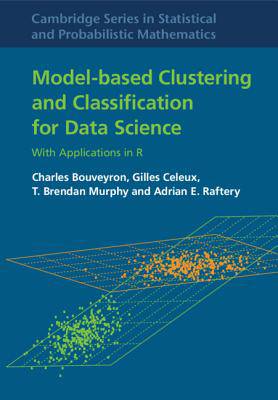
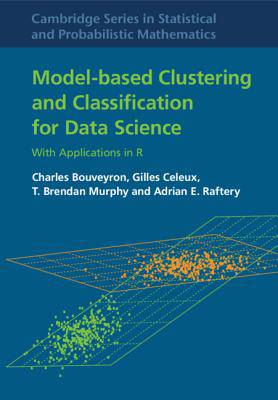
Model-based Clustering and Classification for Data Science
With Applications in R
Charles Bouveyron, Gilles Celeux, T Brendan Murphy
€ 142,95
+ 285 punten
Omschrijving
Cluster analysis finds groups in data automatically. Most methods have been heuristic and leave open such central questions as: how many clusters are there? Which method should I use? How should I handle outliers? Classification assigns new observations to groups given previously classified observations, and also has open questions about parameter tuning, robustness and uncertainty assessment. This book frames cluster analysis and classification in terms of statistical models, thus yielding principled estimation, testing and prediction methods, and sound answers to the central questions. It builds the basic ideas in an accessible but rigorous way, with extensive data examples and R code; describes modern approaches to high-dimensional data and networks; and explains such recent advances as Bayesian regularization, non-Gaussian model-based clustering, cluster merging, variable selection, semi-supervised and robust classification, clustering of functional data, text and images, and co-clustering. Written for advanced undergraduates in data science, as well as researchers and practitioners, it assumes basic knowledge of multivariate calculus, linear algebra, probability and statistics.
Specificaties
Betrokkenen
- Auteur(s):
- Uitgeverij:
Inhoud
- Aantal bladzijden:
- 446
- Taal:
- Engels
- Reeks:
- Reeksnummer:
- nr. 50
Eigenschappen
- Productcode (EAN):
- 9781108494205
- Verschijningsdatum:
- 25/07/2019
- Uitvoering:
- Hardcover
- Formaat:
- Genaaid
- Afmetingen:
- 196 mm x 244 mm
- Gewicht:
- 1088 g


Alleen bij Standaard Boekhandel
+ 285 punten op je klantenkaart van Standaard Boekhandel
AANGERADEN


Beoordelingen
We publiceren alleen reviews die voldoen aan de voorwaarden voor reviews. Bekijk onze voorwaarden voor reviews.