


- Afhalen na 1 uur in een winkel met voorraad
- Gratis thuislevering in België vanaf € 30
- Ruim aanbod met 7 miljoen producten
- Afhalen na 1 uur in een winkel met voorraad
- Gratis thuislevering in België vanaf € 30
- Ruim aanbod met 7 miljoen producten





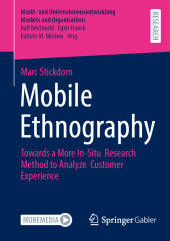
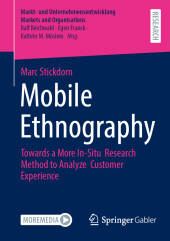
Mobile Ethnography
Towards a More In-Situ Research Method to Analyze Customer Experience
Marc Stickdorn
€ 108,45
+ 216 punten
Omschrijving
This book introduces mobile ethnography as an in-situ qualitative research method that enables participants to document lived experiences on smartphones as they unfold. By capturing in-situ data such as text, photos, videos, audio, ratings, timestamps, and GPS, the method provides rich contextual insight into experiences as they are lived, not just remembered. Visualized as journey maps, customer and employee experience data can be analyzed to identify patterns, pain points, and opportunities for improvement.
Grounded in service design, customer experience research, and ethnography, the book presents a systematic literature review of ethnographic research in leading information systems journals from 2000 to 2025. The review finds increasing methodological transparency, but also persistent gaps in research design, triangulation, and reflexivity. To address these gaps, the author proposes an exemplary research design to strengthen validity and reliability.
Using Design Science Research Methodology, this dissertation develops mobile ethnography as a design artifact comprising the method, participant-facing mobile apps, and web-based analysis software for researchers. Based on seven iterative design cycles, the book shows how participants can become active contributors to customer experience research while maintaining data integrity and motivation. It concludes with implications for AI-supported analysis. In other words: rigorous research, but with dirt under its fingernails.
Specificaties
Betrokkenen
- Auteur(s):
- Uitgeverij:
Inhoud
- Aantal bladzijden:
- 237
- Taal:
- Engels
- Reeks:
Eigenschappen
- Productcode (EAN):
- 9783658515867
- Verschijningsdatum:
- 2/05/2026
- Uitvoering:
- Paperback
- Formaat:
- Trade paperback (VS)
- Afmetingen:
- 148 mm x 210 mm
- Gewicht:
- 346 g


Alleen bij Standaard Boekhandel
+ 216 punten op je klantenkaart van Standaard Boekhandel
Cadeau

AANGERADEN


Beoordelingen
We publiceren alleen reviews die voldoen aan de voorwaarden voor reviews. Bekijk onze voorwaarden voor reviews.