


- Afhalen na 1 uur in een winkel met voorraad
- Gratis thuislevering in België vanaf € 30
- Ruim aanbod met 7 miljoen producten
- Afhalen na 1 uur in een winkel met voorraad
- Gratis thuislevering in België vanaf € 30
- Ruim aanbod met 7 miljoen producten




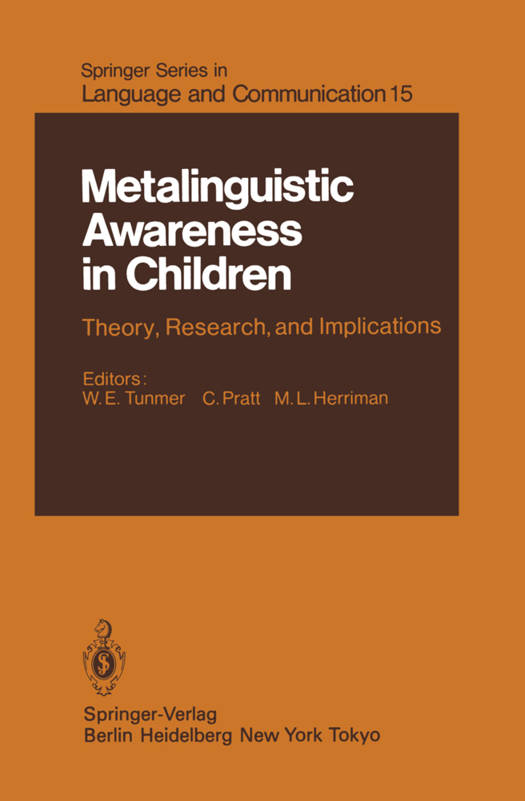
Metalinguistic Awareness in Children
Theory, Research, and Implications
J Bowey, R Grieve, M Herriman, M Myhill, A Nesdale, C Pratt, W E Tunmer
€ 198,45
+ 396 punten
Omschrijving
In the past fi fteen years there has been a growi ng interest in the development of children's awareness of language as an object in itself -- a phenomenon now generally referred to as metal inguistic awareness. Until the publication of an earlier volume in the Springer Series in Language and Communication, The Chitd's Conoeption oi Language, edited by A. Sinclair, R. J. Jarvella, and W. J. M. Levelt, there had been no systematic treatment of metalinguistic awareness. The major goal of that volume was to map out the field of study by describing the phenomenon of interest and defining major theoretical issues. The aim of the present volume is to present an overview of metalinguistic awareness in children which reflects the current state of research and theory. The volume is divided into three major sections. The first considers various conceptual and methodological issues that have arisen from efforts to study metalinguistic awareness. It addresses such questions as what is metalinguistic awareness, when does it begin to emerge, and what tasks and procedures can be employed to assess its development in young children. The second sect ion cri ti ca 11y revi ews the research that has been conducted i nto the four general types of metalinguistic awareness -- phonologieal, word, syntactic, and pragmatic awareness. In the final section the development of metalinguistic awareness is examined in relation to general cognitive development, reading acquisition, bilingualism, and early childhood education.
Specificaties
Betrokkenen
- Auteur(s):
- Uitgeverij:
Inhoud
- Aantal bladzijden:
- 238
- Taal:
- Engels
- Reeks:
- Reeksnummer:
- nr. 15
Eigenschappen
- Productcode (EAN):
- 9783642691157
- Verschijningsdatum:
- 7/12/2011
- Uitvoering:
- Paperback
- Formaat:
- Trade paperback (VS)
- Afmetingen:
- 156 mm x 234 mm
- Gewicht:
- 362 g


Alleen bij Standaard Boekhandel
+ 396 punten op je klantenkaart van Standaard Boekhandel
Wedstrijd


Beoordelingen
We publiceren alleen reviews die voldoen aan de voorwaarden voor reviews. Bekijk onze voorwaarden voor reviews.