


- Afhalen na 1 uur in een winkel met voorraad
- Gratis thuislevering in België vanaf € 30
- Ruim aanbod met 7 miljoen producten
- Afhalen na 1 uur in een winkel met voorraad
- Gratis thuislevering in België vanaf € 30
- Ruim aanbod met 7 miljoen producten





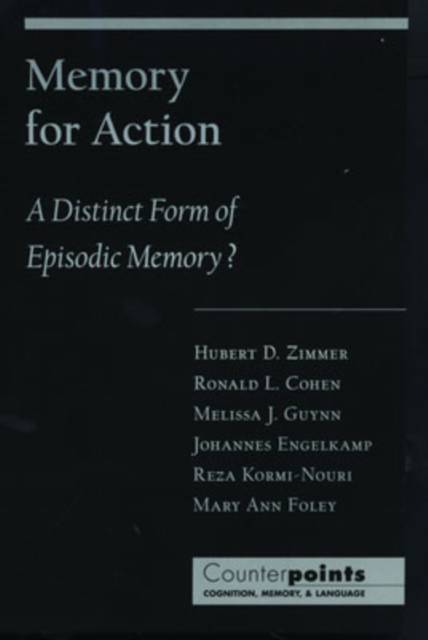
Memory for Action
A Distinct Form of Episodic Memory?
Hubert D Zimmer, Ronald L Cohen, Melissa J Guynn, Johannes Engelkamp, Reza Kormi-Nouri, Mary Ann Foley
€ 62,95
+ 125 punten
Omschrijving
The book presents in eight chapters our actual knowledge on memory for actions and it gives room to the proponents of the opposing models to develop their view for explaining action memory. In Chapter one, Hubert Zimmer and Ronald Cohen summarize the results of laboratory research on action, i. e. memory for self-performed actions. In Chapter two, Melissa Guynn, Mark McDaniel and Gilles Einstein extend this field on memory for intended actions. They present their view on the prospective memory of actions, and they demonstrate the importance of automatic retrieval in prospective memory. In the following chapter, Johannes Engelkamp presents his motor oriented explanation of action memory. He claims that output processes strongly contribute to memory for performed actions, and that the information which is critical for memory is closely related to the information used in the motor control of overt performance. Reza Kormi-Nouri and Lars-Göran Nilsson (Chapter four) completely disagree with this position. They argue that performing actions may cause specific processes, but that nevertheless action memory is part of a unique episodic memory which stores all types of episodes in a similar way. In the following chapter, Mary Ann Foley and Hilary Ratner put action memory in the broader context of activity memory. Everyday actions are usually performed in social contexts and they are goal-oriented. This aspect is seldom relevant in laboratory research, but the authors show that it is of importance for everyday memory. Then two brief chapters follow in which Nilsson and Kormi-Nouri on the one hand, and Engelkamp on the other hand mutually comment on each others position. In the closing chapter, Hubert Zimmer discusses the presented different attempts in parallel. He is doing this by taking into account the different processes and brain modules which are necessary for a successful control of actions.
Specificaties
Betrokkenen
- Auteur(s):
- Uitgeverij:
Inhoud
- Aantal bladzijden:
- 224
- Taal:
- Engels
- Reeks:
Eigenschappen
- Productcode (EAN):
- 9780195115543
- Verschijningsdatum:
- 28/06/2001
- Uitvoering:
- Paperback
- Formaat:
- Trade paperback (VS)
- Afmetingen:
- 152 mm x 229 mm
- Gewicht:
- 322 g



Alleen bij Standaard Boekhandel
+ 125 punten op je klantenkaart van Standaard Boekhandel
Cadeau

AANGERADEN


Beoordelingen
We publiceren alleen reviews die voldoen aan de voorwaarden voor reviews. Bekijk onze voorwaarden voor reviews.