


- Afhalen na 1 uur in een winkel met voorraad
- Gratis thuislevering in België vanaf € 30
- Ruim aanbod met 7 miljoen producten
- Afhalen na 1 uur in een winkel met voorraad
- Gratis thuislevering in België vanaf € 30
- Ruim aanbod met 7 miljoen producten





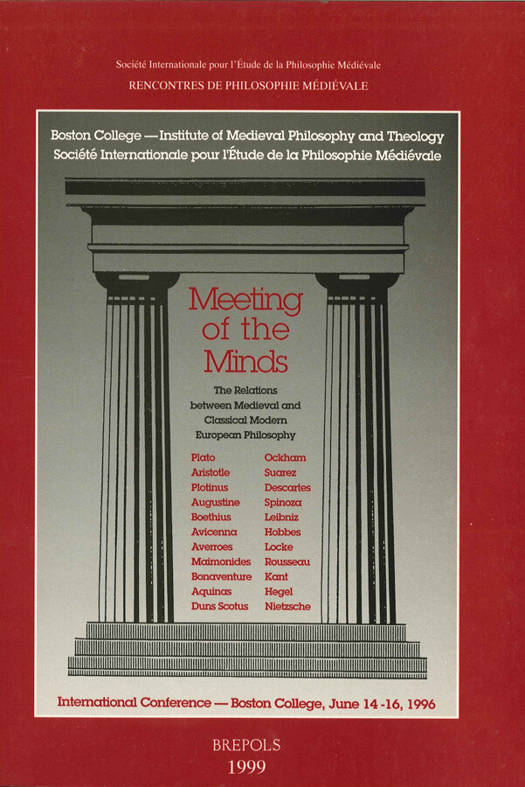
Meeting of the Minds. the Relations Between Medieval and Classical Modern European Philosophy
Acts of the International Colloquium Held at Boston College, June 14-16, 1996, Organized by the Societe Internationale Pour l'Etude de la Philosophie Medievale
S.F. Brown
€ 31,80
+ 63 punten
Omschrijving
Meeting of the Minds records the proceedings of the S.I.E.P.M. conference held in Boston from June 14-16, 1996. The conference participants centred their attention on the relationships between medieval and classical modern philosophy. These relationships have been painted in dramatically different ways by those who have presented overviews of the two eras. Hans Blumenberg, in The Legitimacy of the Modern Age and his subsequent works, discovers the seeds of modernity in the medieval authors themselves. Leo Strauss and his followers see a radical difference between the classical world views of the ancients and medievals and the successive layers of modern thought. These general portraits demand specifics, and the strength of the conference, whose results are contained in this volume, was that it provided many specific examinations of concrete relations between the philosophical positions of celebrated medieval and modern thinkers. Our hope is that this collection of papers will suggest the direction for further cooperative efforts on the interplay of the philosophical views represented by these two eras, and that the issues commonly debated by the medieval and early modern thinkers represented in this volume will give renewed consideration to important philosophical points that have been ignored in more recent debates. The volume contains contributions from E. Jennifer Ashworth (Waterloo, Ontario), Allan Back (Kutztown, Pennsylvania), Jos Decorte (Leuven), Thomas Dewender (Bochum), Idit Dobbs-Weinstein (Nashville), John P.Doyle (St.Louis), Jeremiah Hackett (Columbia, South Carolina), Simo Knuuttila (Helsinki), James McEvoy (Maynooth), A.Stephen McGrade (Storrs), Edward P.Mahoney (Durham, North Carolina), James D.Maliszewski (Toronto), Emily Michael (New York), Woosuk Park (Taejon, Korea), Horacio Santiago-Otero(+) (Madrid), Alison Simmons (Cambridge, Massachusetts), Jean-Luc Solere (Paris), Jose MariSoto Rabanos (Madrid), and Eileen C. Swe.
Specificaties
Betrokkenen
- Auteur(s):
- Uitgeverij:
Inhoud
- Aantal bladzijden:
- 528
- Taal:
- Engels
- Reeks:
- Reeksnummer:
- nr. 7
Eigenschappen
- Productcode (EAN):
- 9782503508740
- Verschijningsdatum:
- 7/04/1999
- Uitvoering:
- Paperback
- Formaat:
- Trade paperback (VS)
- Afmetingen:
- 168 mm x 239 mm
- Gewicht:
- 975 g


Alleen bij Standaard Boekhandel
+ 63 punten op je klantenkaart van Standaard Boekhandel
Cadeau

AANGERADEN


Beoordelingen
We publiceren alleen reviews die voldoen aan de voorwaarden voor reviews. Bekijk onze voorwaarden voor reviews.