


- Afhalen na 1 uur in een winkel met voorraad
- Gratis thuislevering in België vanaf € 30
- Ruim aanbod met 7 miljoen producten
- Afhalen na 1 uur in een winkel met voorraad
- Gratis thuislevering in België vanaf € 30
- Ruim aanbod met 7 miljoen producten





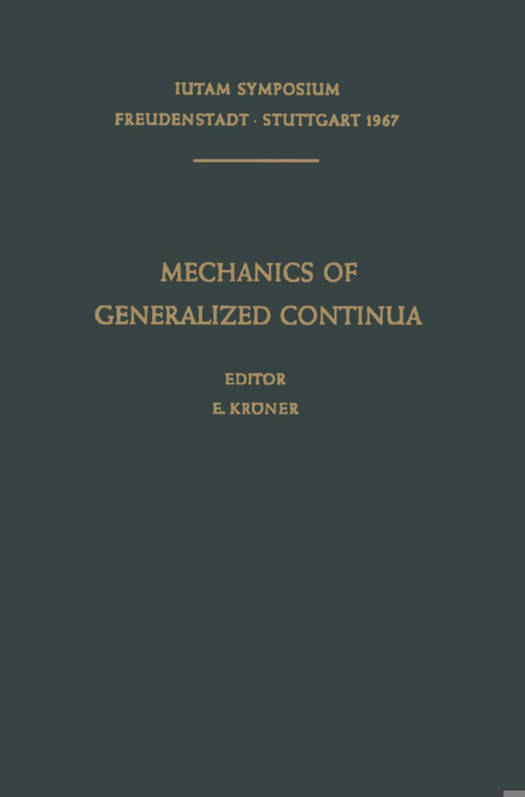
Mechanics of Generalized Continua
Proceedings of the Iutam-Symposium on the Generalized Cosserat Continuum and the Continuum Theory of Dislocations with Applications, Freudenstadt and Stuttgart (Germany) 1967
€ 138,95
+ 277 punten
Omschrijving
5 The symposium was held in Freudenstadt from 28\h to 31 \ ofAugust st nd 1967 and in Stuttgart from 1 to 2 of September 1967. The proposal to hold this symposium originated with the German Society of Applied Mathematics and Mechanics (GAMM) late in 1964 and was examined by a committee of IUTAM especially appointed for this purpose. The basis of this examination was a report in which the present situation in the field and the possible aims of the symposium were surveyed. Briefly, the aims of the symposium were stated to be 1. the unification of the various approaches developed in recent years with the aim of penetrating into the microscopic world of matter by means of continuum theories; 2. the bridging of the gap between microscopic (or atomic) research on mechanics on one hand, and the phenomenological (or continuum mechanical) approach on the other hand; 3. the physical interpretation and the relation to actual material behaviour of the quantities and laws introduced into the new theories, together with applications; 4. the further development of the theories, where necessary, and the clarification of open questions; 5. a stocktaking of present achievements and the prognosis for future developments. The committee agreed unanimously that the topic of the symposium represented an important phase of current developments in continuum mechanics, from the purely theoretical point of view as well as in connection with possible applications to actual materials.
Specificaties
Betrokkenen
- Uitgeverij:
Inhoud
- Aantal bladzijden:
- 358
- Taal:
- Engels
- Reeks:
Eigenschappen
- Productcode (EAN):
- 9783662302590
- Verschijningsdatum:
- 23/08/2014
- Uitvoering:
- Paperback
- Formaat:
- Trade paperback (VS)
- Afmetingen:
- 156 mm x 234 mm
- Gewicht:
- 521 g

Alleen bij Standaard Boekhandel
+ 277 punten op je klantenkaart van Standaard Boekhandel
AANGERADEN


Beoordelingen
We publiceren alleen reviews die voldoen aan de voorwaarden voor reviews. Bekijk onze voorwaarden voor reviews.