



Bedankt voor het vertrouwen het afgelopen jaar! Om jou te bedanken bieden we GRATIS verzending (in België) aan op alles gedurende de hele maand januari.
- Afhalen na 1 uur in een winkel met voorraad
- In januari gratis thuislevering in België
- Ruim aanbod met 7 miljoen producten
Bedankt voor het vertrouwen het afgelopen jaar! Om jou te bedanken bieden we GRATIS verzending (in België) aan op alles gedurende de hele maand januari.
- Afhalen na 1 uur in een winkel met voorraad
- In januari gratis thuislevering in België
- Ruim aanbod met 7 miljoen producten





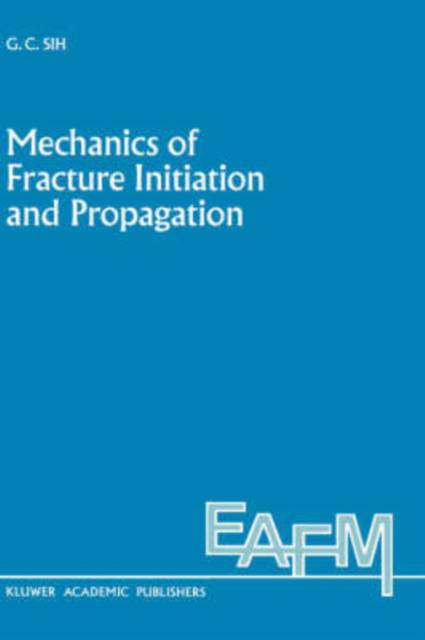
Mechanics of Fracture Initiation and Propagation
Surface and Volume Energy Density Applied as Failure Criterion
George C Sih
€ 251,45
+ 502 punten
Uitvoering
Omschrijving
The assessment of crack initiation and/or propagation has been the subject of many past discussions on fracture mechanics. Depending on how the chosen failure criterion is combined with the solution of a particular theory of continuum mechanics, the outcome could vary over a wide range. Mod- elling of the material damage process could be elusive if the scale level of observation is left undefined. The specification of physical dimension alone is not sufficient because time and temperature also play an intimate role. It is only when the latter two variables are fixed that failure predictions can be simplified. The sudden fracture of material with a pre-existing crack is a case in point. Barring changes in the local temperature, * the energy released to create a unit surface area of an existing crack can be obtained by considering the change in elastic energy of the system before and after crack extension. Such a quantity has been referred to as the critical energy release rate, G e, or stress intensity factor, K Ie. Other parameters, such as the crack opening displacement (COD), path-independent J-integral, etc., have been proposed; their relation to the fracture process is also based on the energy release concept. These one-parameter approaches, however, are unable simultaneously to account for the failure process of crack initiation, propagation and onset of rapid fracture. A review on the use of G, K I, COD, J, etc., has been made by Sih [1,2].
Specificaties
Betrokkenen
- Auteur(s):
- Uitgeverij:
Inhoud
- Aantal bladzijden:
- 410
- Taal:
- Engels
- Reeks:
- Reeksnummer:
- nr. 11
Eigenschappen
- Productcode (EAN):
- 9780792308775
- Verschijningsdatum:
- 30/04/1991
- Uitvoering:
- Hardcover
- Formaat:
- Genaaid
- Afmetingen:
- 156 mm x 234 mm
- Gewicht:
- 784 g


Alleen bij Standaard Boekhandel
+ 502 punten op je klantenkaart van Standaard Boekhandel
SOLDEN


Beoordelingen
We publiceren alleen reviews die voldoen aan de voorwaarden voor reviews. Bekijk onze voorwaarden voor reviews.