



Je cadeautjes zeker op tijd in huis hebben voor de feestdagen? Kom langs in onze winkels en vind het perfecte geschenk!
- Afhalen na 1 uur in een winkel met voorraad
- Gratis thuislevering in België vanaf € 30
- Ruim aanbod met 7 miljoen producten
Je cadeautjes zeker op tijd in huis hebben voor de feestdagen? Kom langs in onze winkels en vind het perfecte geschenk!
- Afhalen na 1 uur in een winkel met voorraad
- Gratis thuislevering in België vanaf € 30
- Ruim aanbod met 7 miljoen producten





Omschrijving
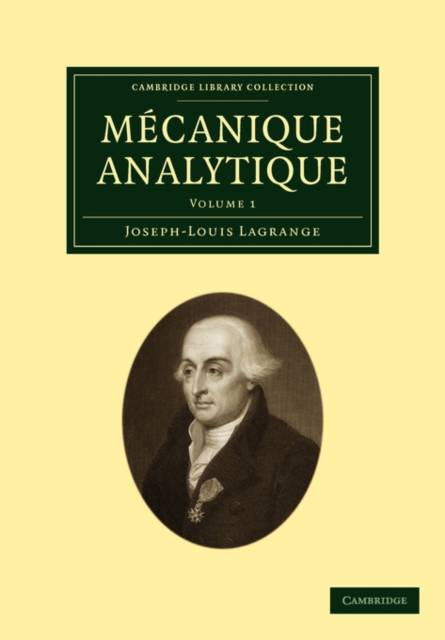
Joseph-Louis Lagrange (1736-1813), one of the notable French mathematicians of the Revolutionary period, is remembered for his work in the fields of analysis, number theory and mechanics. Like Laplace and Legendre, Lagrange was assisted by d'Alembert, and it was on the recommendation of the latter and the urging of Frederick the Great himself that Lagrange succeeded Euler as the director of mathematics at the Prussian Academy of Sciences in Berlin. The two-volume Mécanique analytique was first published in 1788; the edition presented here is that of 1811-15, revised by the author before his death. In this work, claimed to be the most important on classical mechanics since Newton, Lagrange developed the law of virtual work, from which single principle the whole of solid and fluid mechanics can be derived.
Specificaties
Betrokkenen
- Auteur(s):
- Uitgeverij:
Inhoud
- Aantal bladzijden:
- 444
- Taal:
- Engels
- Reeks:
Eigenschappen
- Productcode (EAN):
- 9781108001755
- Verschijningsdatum:
- 20/07/2009
- Uitvoering:
- Paperback
- Formaat:
- Trade paperback (VS)
- Afmetingen:
- 170 mm x 244 mm
- Gewicht:
- 703 g


Alleen bij Standaard Boekhandel
+ 193 punten op je klantenkaart van Standaard Boekhandel
CADEAU


Beoordelingen
We publiceren alleen reviews die voldoen aan de voorwaarden voor reviews. Bekijk onze voorwaarden voor reviews.