


- Afhalen na 1 uur in een winkel met voorraad
- Gratis thuislevering in België vanaf € 30
- Ruim aanbod met 7 miljoen producten
- Afhalen na 1 uur in een winkel met voorraad
- Gratis thuislevering in België vanaf € 30
- Ruim aanbod met 7 miljoen producten





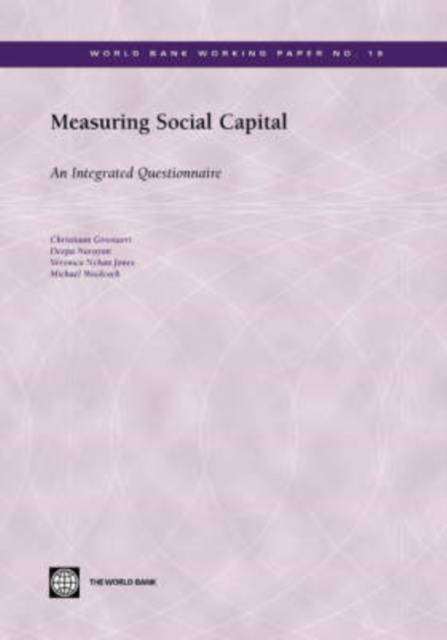
Measuring Social Capital
An Integrated Questionnaire
Christiaan Grootaert, Deepa Narayan, Nyhan Jones Veronica
€ 32,45
+ 64 punten
Omschrijving
Measuring Social Capital: An Integrated Questionnaire is part of the World Bank Working Paper series. These papers are published to communicate the results of the Bank's ongoing research and to stimulate public discussion. The idea of social capital has enjoyed a remarkable rise to prominence in both the theoretical and applied social science literature over the last decade. While lively debate has accompanied that journey, thereby helping to advance our thinking and clarifying areas of agreement and disagreement, much still remains to be done. One approach that could help bring further advances for both scholars and practitioners is providing a set of empirical tools for measuring social capital. The purpose of this paper is to introduce such a tool with a focus on applications in developing countries. The tool aims to generate quantitative data on various dimensions of social capital as part of a larger household survey (such as the Living Standards Measurement Survey or a household income/expenditure survey). The paper also provides detailed guidance for the use and analysis of the data. In having better empirical information on social capital, the authors aim is to enable greater dialogue between researchers, policy makers, task managers, and poor people themselves, ultimately leading to the design and implementation of more effective poverty reduction strategies.
Specificaties
Betrokkenen
- Auteur(s):
- Uitgeverij:
Inhoud
- Aantal bladzijden:
- 62
- Taal:
- Engels
- Reeks:
- Reeksnummer:
- nr. 18
Eigenschappen
- Productcode (EAN):
- 9780821356616
- Verschijningsdatum:
- 4/02/2004
- Uitvoering:
- Paperback
- Formaat:
- Trade paperback (VS)
- Afmetingen:
- 178 mm x 254 mm
- Gewicht:
- 145 g


Alleen bij Standaard Boekhandel
+ 64 punten op je klantenkaart van Standaard Boekhandel
Cadeau

AANGERADEN


Beoordelingen
We publiceren alleen reviews die voldoen aan de voorwaarden voor reviews. Bekijk onze voorwaarden voor reviews.