


- Afhalen na 1 uur in een winkel met voorraad
- Gratis thuislevering in België vanaf € 30
- Ruim aanbod met 7 miljoen producten
- Afhalen na 1 uur in een winkel met voorraad
- Gratis thuislevering in België vanaf € 30
- Ruim aanbod met 7 miljoen producten





€ 47,00
+ 94 punten
Omschrijving
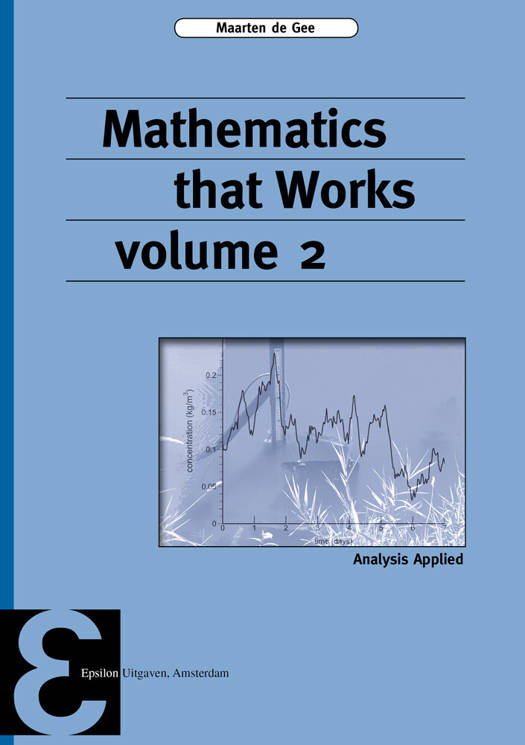
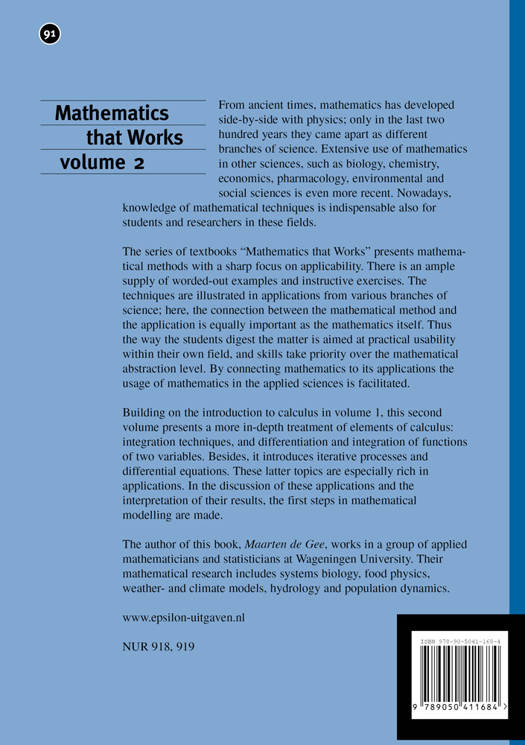
From ancient times, mathematics has developed side-by-side with physics; only in the last two hundred years they came apart as different branches of science. Extensive use of mathematics in other sciences, such as biology, chemistry, economics, pharmacology, environmental and social sciences is even more recent. Nowadays, knowledge of mathematical techniques is indispensable also for students and researchers in these fields.
The series of textbooks “Mathematics that Works” presents mathematical methods with a sharp focus on applicability. There is an ample supply of worded-out examples and instructive exercises. The techniques are illustrated in applications from various branches of science; here, the connection between the mathematical method and the application is equally important as the mathematics itself. Thus the way the students digest the matter is aimed at practical usability within their own field, and skills take priority over the mathematical abstraction level. By connecting mathematics to its applications the usage of mathematics in the applied sciences is facilitated.
Building on the introduction to calculus in volume 1, this second volume presents a more in-depth treatment of elements of calculus: integration techniques, and differentiation and integration of functions of two variables. Besides, it introduces iterative processes and differential equations. These latter topics are especially rich in applications. In the discussion of these applications and the interpretation of their results, the first steps in mathematical modelling are made.
The series of textbooks “Mathematics that Works” presents mathematical methods with a sharp focus on applicability. There is an ample supply of worded-out examples and instructive exercises. The techniques are illustrated in applications from various branches of science; here, the connection between the mathematical method and the application is equally important as the mathematics itself. Thus the way the students digest the matter is aimed at practical usability within their own field, and skills take priority over the mathematical abstraction level. By connecting mathematics to its applications the usage of mathematics in the applied sciences is facilitated.
Building on the introduction to calculus in volume 1, this second volume presents a more in-depth treatment of elements of calculus: integration techniques, and differentiation and integration of functions of two variables. Besides, it introduces iterative processes and differential equations. These latter topics are especially rich in applications. In the discussion of these applications and the interpretation of their results, the first steps in mathematical modelling are made.
Specificaties
Betrokkenen
- Auteur(s):
- Uitgeverij:
Inhoud
- Aantal bladzijden:
- 410
- Taal:
- Engels
- Reeks:
- Reeksnummer:
- nr. 91
- Geïllustreerd:
- Ja
Eigenschappen
- Productcode (EAN):
- 9789050411684
- Verschijningsdatum:
- 24/06/2020
- Uitvoering:
- Paperback
- Afmetingen:
- 170 mm x 240 mm
- Gewicht:
- 770 g



Alleen bij Standaard Boekhandel
+ 94 punten op je klantenkaart van Standaard Boekhandel
Cadeau

AANGERADEN


Beoordelingen
We publiceren alleen reviews die voldoen aan de voorwaarden voor reviews. Bekijk onze voorwaarden voor reviews.