



Bedankt voor het vertrouwen het afgelopen jaar! Om jou te bedanken bieden we GRATIS verzending (in België) aan op alles gedurende de hele maand januari.
- Afhalen na 1 uur in een winkel met voorraad
- In januari gratis thuislevering in België
- Ruim aanbod met 7 miljoen producten
Bedankt voor het vertrouwen het afgelopen jaar! Om jou te bedanken bieden we GRATIS verzending (in België) aan op alles gedurende de hele maand januari.
- Afhalen na 1 uur in een winkel met voorraad
- In januari gratis thuislevering in België
- Ruim aanbod met 7 miljoen producten





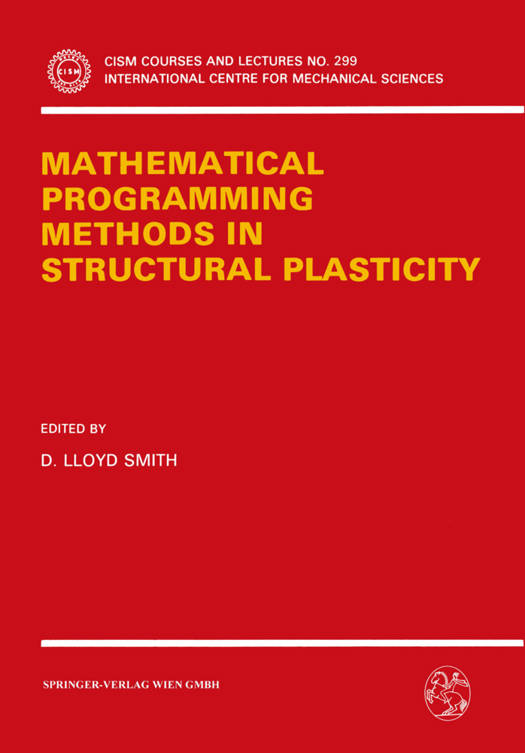
Mathematical Programming Methods in Structural Plasticity
€ 106,95
+ 213 punten
Omschrijving
Civil engineering structures tend to be fabricated from materials that respond elastically at normal levels of loading. Most such materials, however, would exhibit a marked and ductile inelasticity if the structure were overloaded by accident or by some improbable but naturally occuring phenomeon. Indeed, the very presence of such ductility constitutes an important safety provision for large-scale constructions where human life is at risk. In the comprehensive evaluation of safety in structural design, it is therefore unrealistic not to consider the effects of ductility. This book sets out to show that the bringing together of the theory and methods of mathematical programming with the mathematical theory of plasticity furnishes a model which has a unifying theoretical nature and is entirely representative of observed structural behaviour. The contents of the book provide a review of the relevant aspects of mathematical programming and plasticity theory, together with a detailed presentation of the most interesting and potentially useful applications in both framed and continuum structures: ultimate strength and elastoplastic deformability; shakedown and practical upper bounds on deformation measures; evolutive dynamic response; large displacements and instability; stochastic and fuzzy programming for representing uncertainty in ultimate strength calculations. Besides providing a ready fund of computational algorithms, mathematical programming invests applications in mechanics with a refined mathematical formalism, rich in fundamental theorems, which often gives addi- tional insight into known results and occasionally lead to new ones. In addition to its obvious practical utility, the educational value of the material thoroughly befits a university discipline.
Specificaties
Betrokkenen
- Uitgeverij:
Inhoud
- Aantal bladzijden:
- 435
- Taal:
- Engels
- Reeks:
- Reeksnummer:
- nr. 299
Eigenschappen
- Productcode (EAN):
- 9783211821916
- Verschijningsdatum:
- 18/05/1990
- Uitvoering:
- Paperback
- Formaat:
- Trade paperback (VS)
- Afmetingen:
- 170 mm x 244 mm
- Gewicht:
- 707 g

Alleen bij Standaard Boekhandel
+ 213 punten op je klantenkaart van Standaard Boekhandel
SOLDEN


Beoordelingen
We publiceren alleen reviews die voldoen aan de voorwaarden voor reviews. Bekijk onze voorwaarden voor reviews.