


- Afhalen na 1 uur in een winkel met voorraad
- Gratis thuislevering in België vanaf € 30
- Ruim aanbod met 7 miljoen producten
- Afhalen na 1 uur in een winkel met voorraad
- Gratis thuislevering in België vanaf € 30
- Ruim aanbod met 7 miljoen producten





€ 151,95
+ 303 punten
Omschrijving
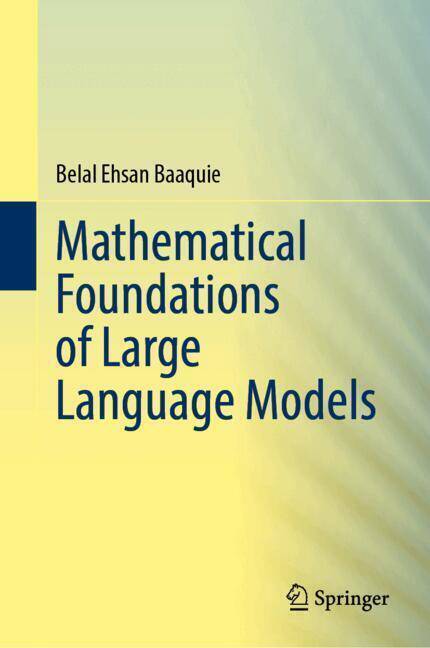
This book emerged from a simple observation: while Large Language Models (LLMs) have become ubiquitous, their mathematical foundations remain opaque to many practitioners, students, and enthusiasts. This book bridges that gap by presenting LLMs from first principles - not as a black box, but as an elegant mathematical construction. The journey begins with the simplest language models - bigrams and n-grams - and progressively builds toward the transformer architecture that powers modern LLMs. The emphasize is on clarity over completeness, intuition over implementation details, and mathematical rigor over hand-waving explanations. This book is self-contained and only assumes familiarity with undergraduate-level linear algebra, probability, and calculus. Wherever possible, the abstract concepts are connected to concrete examples, often using minimal two word vocabularies to illuminate general principles. The hope is that this primer serves as both an introduction for newcomers and a reference for practitioners seeking deeper understanding of the mathematical machinery underlying today's most influential AI systems.
Specificaties
Betrokkenen
- Auteur(s):
- Uitgeverij:
Inhoud
- Taal:
- Engels
Eigenschappen
- Productcode (EAN):
- 9789819204656
- Verschijningsdatum:
- 11/09/2026
- Uitvoering:
- Hardcover
- Afmetingen:
- 155 mm x 235 mm


Alleen bij Standaard Boekhandel
+ 303 punten op je klantenkaart van Standaard Boekhandel
AANGERADEN


Beoordelingen
We publiceren alleen reviews die voldoen aan de voorwaarden voor reviews. Bekijk onze voorwaarden voor reviews.