


- Afhalen na 1 uur in een winkel met voorraad
- Gratis thuislevering in België vanaf € 30
- Ruim aanbod met 7 miljoen producten
- Afhalen na 1 uur in een winkel met voorraad
- Gratis thuislevering in België vanaf € 30
- Ruim aanbod met 7 miljoen producten





€ 140,95
+ 281 punten
Omschrijving
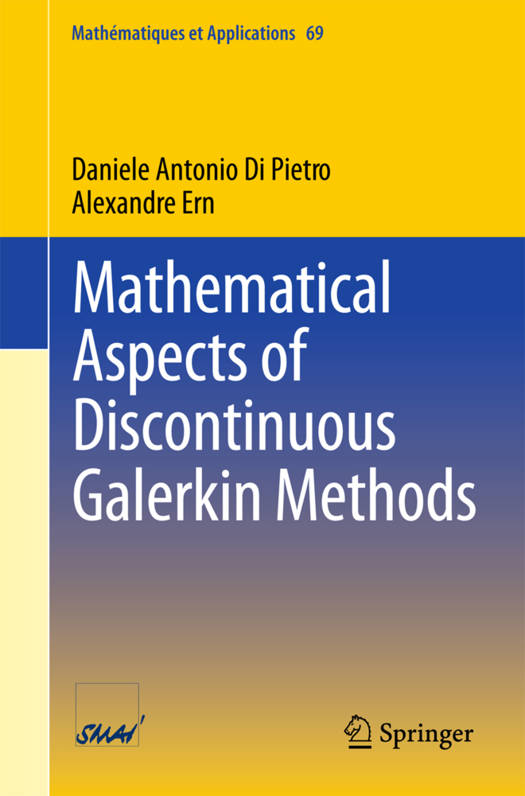
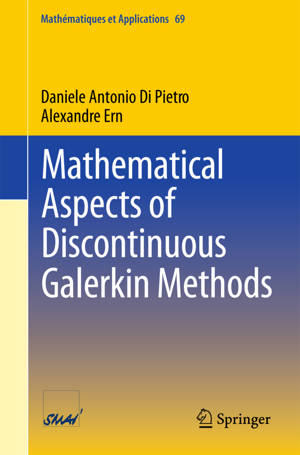
This book introduces the basic ideas to build discontinuous Galerkin methods and, at the same time, incorporates several recent mathematical developments. The presentation is to a large extent self-contained and is intended for graduate students and researchers in numerical analysis. The material covers a wide range of model problems, both steady and unsteady, elaborating from advection-reaction and diffusion problems up to the Navier-Stokes equations and Friedrichs' systems. Both finite element and finite volume viewpoints are exploited to convey the main ideas underlying the design of the approximation. The analysis is presented in a rigorous mathematical setting where discrete counterparts of the key properties of the continuous problem are identified. The framework encompasses fairly general meshes regarding element shapes and hanging nodes. Salient implementation issues are also addressed.
Specificaties
Betrokkenen
- Auteur(s):
- Uitgeverij:
Inhoud
- Aantal bladzijden:
- 384
- Taal:
- Engels
- Reeks:
- Reeksnummer:
- nr. 69
Eigenschappen
- Productcode (EAN):
- 9783642229794
- Verschijningsdatum:
- 4/11/2011
- Uitvoering:
- Paperback
- Formaat:
- Trade paperback (VS)
- Afmetingen:
- 152 mm x 229 mm
- Gewicht:
- 521 g


Alleen bij Standaard Boekhandel
+ 281 punten op je klantenkaart van Standaard Boekhandel
Cadeau

AANGERADEN


Beoordelingen
We publiceren alleen reviews die voldoen aan de voorwaarden voor reviews. Bekijk onze voorwaarden voor reviews.