


- Afhalen na 1 uur in een winkel met voorraad
- Gratis thuislevering in België vanaf € 30
- Ruim aanbod met 7 miljoen producten
- Afhalen na 1 uur in een winkel met voorraad
- Gratis thuislevering in België vanaf € 30
- Ruim aanbod met 7 miljoen producten





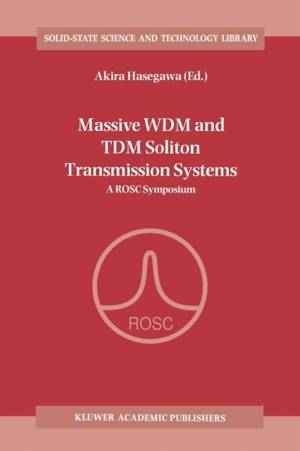
Massive Wdm and Tdm Soliton Transmission Systems
A Rosc Symposium
€ 223,95
+ 447 punten
Omschrijving
This book summarizes the proceedings of the invited talks presented at the "International Symposium on Massive TDM and WDM Optical Soliton Tra- mission Systems" held in Kyoto during November 9-12, 1999. The symposium is the third of the series organized by Research Group for Optical Soliton C- munications (ROSC) chaired by Akira Hasegawa. The research group, ROSC, was established in Japan in April 1995 with a support of the Japanese Ministry of Post and Telecommunications to promote collaboration and information - change among communication service companies, communication industries and academic circles in the theory and application of optical solitons. The symposium attracted enthusiastic response from worldwide researchers in the field of soliton based communications and intensive discussions were made. In the symposium held in 1997, new concept of soliton transmission based on dispersion management of optical fibers were presented. This new soliton is now called the dispersion managed soliton. The present symposium mainly focuses the theoretical and experimental developments of dispersion managed solitons. It is remarkable that the concept of the dispersion managed soliton, which was just born two years ago when the naming was not even given yet, has become the center of soliton research in two years. The dispersion managed soliton has an enhanced power in maintaining reasonable signal to noise ratio, yet has reduced Gordon-Haus timing jitter by reduced averagedispersion. The dispersion managed soliton also has demonstrated its power in soliton based WDM transmissions.
Specificaties
Betrokkenen
- Uitgeverij:
Inhoud
- Aantal bladzijden:
- 439
- Taal:
- Engels
- Reeks:
- Reeksnummer:
- nr. 6
Eigenschappen
- Productcode (EAN):
- 9781402003615
- Verschijningsdatum:
- 30/11/2001
- Uitvoering:
- Paperback
- Formaat:
- Trade paperback (VS)
- Afmetingen:
- 160 mm x 234 mm
- Gewicht:
- 657 g

Alleen bij Standaard Boekhandel
+ 447 punten op je klantenkaart van Standaard Boekhandel
Wedstrijd


Beoordelingen
We publiceren alleen reviews die voldoen aan de voorwaarden voor reviews. Bekijk onze voorwaarden voor reviews.