



Bedankt voor het vertrouwen het afgelopen jaar! Om jou te bedanken bieden we GRATIS verzending (in België) aan op alles gedurende de hele maand januari.
- Afhalen na 1 uur in een winkel met voorraad
- In januari gratis thuislevering in België
- Ruim aanbod met 7 miljoen producten
Bedankt voor het vertrouwen het afgelopen jaar! Om jou te bedanken bieden we GRATIS verzending (in België) aan op alles gedurende de hele maand januari.
- Afhalen na 1 uur in een winkel met voorraad
- In januari gratis thuislevering in België
- Ruim aanbod met 7 miljoen producten





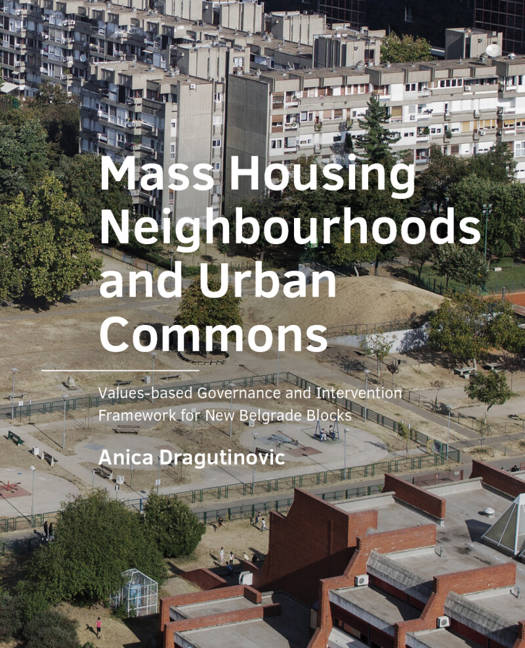
Mass Housing Neighbourhoods and Urban Commons
Values-based Governance and Intervention Framework for New Belgrade Blocks
Anica Dragutinovic
€ 29,95
+ 59 punten
Omschrijving
The neglect of significance, deterioration and consequent devaluation of the post-war mass housing neighbourhoods are major challenges, both in the field of heritage conservation and management and in urban planning and design. The reasons for their deterioration are different, and interlinked with the socio-cultural discourse, as well as the spatial characteristics of these neighbourhoods. This doctoral research addresses the challenges of those neighbourhoods, focusing on New Belgrade Blocks, as one of the largest modernist post-war mass housing areas in Europe. The case is particularly important for the discourse on mass housing and ‘ordinary’ heritage management, as it encapsulates concepts, policies and practices developed in Yugoslavia, which are relevant to the contemporary discussions on community-driven approaches for urban planning and governance and participation in heritage studies. The doctoral thesis presents this legacy and reveals causalities and relations of spatial and socio-political aspects, policies, but also planning and design principles. Furthermore, it empirically studies and evaluates the blocks in the contemporary context, with the society (involving citizens), and within the current legal and organisational conditions. Eventually, it develops a framework for enhancement of the blocks, addressing the current and future societal and users’ needs, while preserving the identity and values of the blocks. The doctoral thesis provides different findings and perspectives, contributing to the current knowledge on integrated conservation, urban planning and governance of urban heritage, and in particular mass housing neighbourhoods. It shows co-dependence of those fields and offers an integrative and cross-disciplinary approach.
Specificaties
Betrokkenen
- Auteur(s):
- Uitgeverij:
Inhoud
- Aantal bladzijden:
- 272
- Taal:
- Engels
- Reeks:
Eigenschappen
- Productcode (EAN):
- 9789463667357
- Verschijningsdatum:
- 8/09/2023
- Uitvoering:
- Paperback
- Afmetingen:
- 191 mm x 235 mm
- Gewicht:
- 635 g


Alleen bij Standaard Boekhandel
+ 59 punten op je klantenkaart van Standaard Boekhandel
SOLDEN


Beoordelingen
We publiceren alleen reviews die voldoen aan de voorwaarden voor reviews. Bekijk onze voorwaarden voor reviews.