


- Afhalen na 1 uur in een winkel met voorraad
- Gratis thuislevering in België vanaf € 30
- Ruim aanbod met 7 miljoen producten
- Afhalen na 1 uur in een winkel met voorraad
- Gratis thuislevering in België vanaf € 30
- Ruim aanbod met 7 miljoen producten





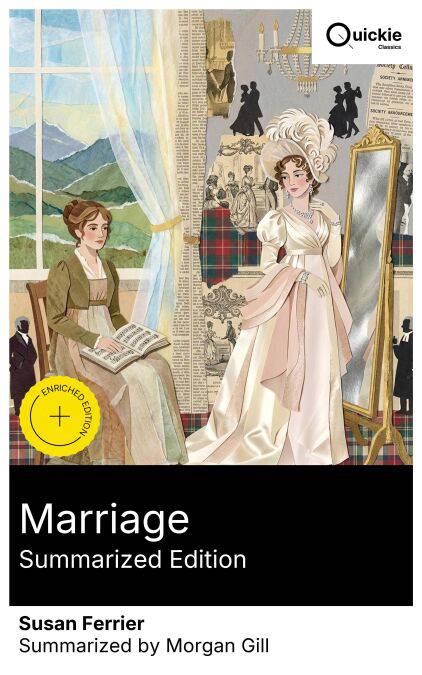
Marriage (Summarized Edition) E-BOOK
Enriched edition. Courtship, wit, and social commentary in Regency Britain: a romance exploring female empowerment within a patriarchal society
Susan Ferrier
E-book | Engels
€ 1,99
+ 1 punten
Eenvoudig bestellen
Veilig betalen


Onmiddellijk geleverd via e-mail
Omschrijving
Marriage (1818) is a spirited comedy of manners that anatomizes the delusions of the nuptial marketplace. Through the misalliance of spoiled Lady Juliana and the impecunious Highlander Henry Douglas, and the divergent fates of their daughters, Adelaide and Mary, Ferrier contrasts fashionable London vanity with Scottish domestic prudence. Her omniscient narrator, tart asides, and deft Scots idiom yield portraits at once comic and corrective. In dialogue with Edgeworth's national tale and Austen's marriage plots, the novel probes female education, class pretension, and the ethics of choice across Edinburgh, the Highlands, and London. Ferrier, an Edinburgh novelist who published anonymously with Blackwood and was encouraged by Walter Scott, drew on an upbringing among legal and clerical elites and on Highland visits to craft her scenes. A Presbyterian moral sense tempers her satire, while the capital's intellectual circle honed the observational acuity that animates household economies and kinship skirmishes. This edition rewards readers of Austen, Edgeworth, and Scott, as well as scholars of British and Scottish studies, gender, and the history of the novel. Read Marriage for its brisk wit, its shrewd anthropology of courtship and kin, and its enduring argument that sense, not splendor, is the soundest dowry.
Quickie Classics summarizes timeless works with precision, preserving the author's voice and keeping the prose clear, fast, and readable—distilled, never diluted. Enriched Edition extras: Introduction · Synopsis · Historical Context · Brief Analysis · 4 Reflection Q&As · Editorial Footnotes.
Quickie Classics summarizes timeless works with precision, preserving the author's voice and keeping the prose clear, fast, and readable—distilled, never diluted. Enriched Edition extras: Introduction · Synopsis · Historical Context · Brief Analysis · 4 Reflection Q&As · Editorial Footnotes.
Specificaties
Betrokkenen
- Auteur(s):
- Uitgeverij:
Inhoud
- Aantal bladzijden:
- 135
- Taal:
- Engels
Eigenschappen
- Productcode (EAN):
- 8596547883043
- Verschijningsdatum:
- 9/01/2026
- Uitvoering:
- E-book
- Beveiligd met:
- Digital watermarking
- Formaat:
- ePub


Alleen bij Standaard Boekhandel
+ 1 punten op je klantenkaart van Standaard Boekhandel
CADEAU

AANGERADEN


Beoordelingen
We publiceren alleen reviews die voldoen aan de voorwaarden voor reviews. Bekijk onze voorwaarden voor reviews.