


- Afhalen na 1 uur in een winkel met voorraad
- Gratis thuislevering in België vanaf € 30
- Ruim aanbod met 7 miljoen producten
- Afhalen na 1 uur in een winkel met voorraad
- Gratis thuislevering in België vanaf € 30
- Ruim aanbod met 7 miljoen producten





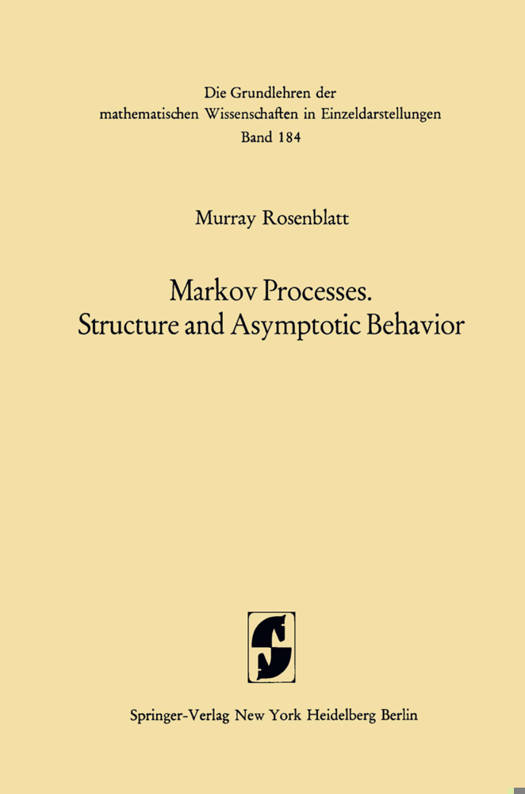
Markov Processes, Structure and Asymptotic Behavior
Structure and Asymptotic Behavior
Murray Rosenblatt
€ 53,45
+ 106 punten
Omschrijving
This book is concerned with a set of related problems in probability theory that are considered in the context of Markov processes. Some of these are natural to consider, especially for Markov processes. Other problems have a broader range of validity but are convenient to pose for Markov processes. The book can be used as the basis for an interesting course on Markov processes or stationary processes. For the most part these questions are considered for discrete parameter processes, although they are also of obvious interest for continuous time parameter processes. This allows one to avoid the delicate measure theoretic questions that might arise in the continuous parameter case. There is an attempt to motivate the material in terms of applications. Many of the topics concern general questions of structure and representation of processes that have not previously been presented in book form. A set of notes comment on the many problems that are still left open and related material in the literature. It is also hoped that the book will be useful as a reference to the reader who would like an introduction to these topics as well as to the reader interested in extending and completing results of this type.
Specificaties
Betrokkenen
- Auteur(s):
- Uitgeverij:
Inhoud
- Aantal bladzijden:
- 270
- Taal:
- Engels
- Reeks:
- Reeksnummer:
- nr. 184
Eigenschappen
- Productcode (EAN):
- 9783642652400
- Verschijningsdatum:
- 11/11/2011
- Uitvoering:
- Paperback
- Formaat:
- Trade paperback (VS)
- Afmetingen:
- 152 mm x 229 mm
- Gewicht:
- 394 g


Alleen bij Standaard Boekhandel
+ 106 punten op je klantenkaart van Standaard Boekhandel
AANGERADEN


Beoordelingen
We publiceren alleen reviews die voldoen aan de voorwaarden voor reviews. Bekijk onze voorwaarden voor reviews.