



Je cadeautjes zeker op tijd in huis hebben voor de feestdagen? Kom langs in onze winkels en vind het perfecte geschenk!
- Afhalen na 1 uur in een winkel met voorraad
- Gratis thuislevering in België vanaf € 30
- Ruim aanbod met 7 miljoen producten
Je cadeautjes zeker op tijd in huis hebben voor de feestdagen? Kom langs in onze winkels en vind het perfecte geschenk!
- Afhalen na 1 uur in een winkel met voorraad
- Gratis thuislevering in België vanaf € 30
- Ruim aanbod met 7 miljoen producten





Omschrijving
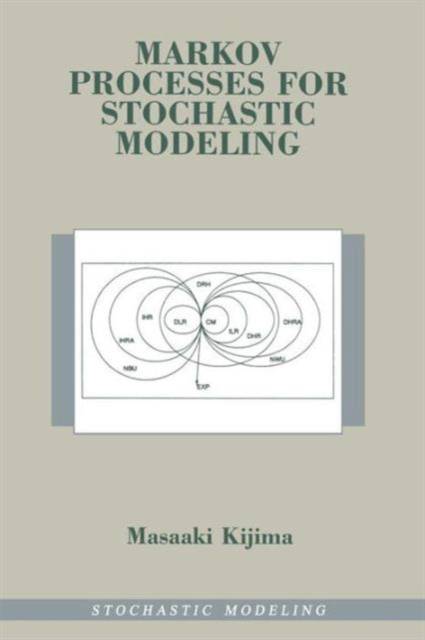
This book presents an algebraic development of the theory of countable state space Markov chains with discrete- and continuous-time parameters. A Markov chain is a stochastic process characterized by the Markov prop- erty that the distribution of future depends only on the current state, not on the whole history. Despite its simple form of dependency, the Markov property has enabled us to develop a rich system of concepts and theorems and to derive many results that are useful in applications. In fact, the areas that can be modeled, with varying degrees of success, by Markov chains are vast and are still expanding. The aim of this book is a discussion of the time-dependent behavior, called the transient behavior, of Markov chains. From the practical point of view, when modeling a stochastic system by a Markov chain, there are many instances in which time-limiting results such as stationary distributions have no meaning. Or, even when the stationary distribution is of some importance, it is often dangerous to use the stationary result alone without knowing the transient behavior of the Markov chain. Not many books have paid much attention to this topic, despite its obvious importance.
Specificaties
Betrokkenen
- Auteur(s):
- Uitgeverij:
Inhoud
- Aantal bladzijden:
- 341
- Taal:
- Engels
Eigenschappen
- Productcode (EAN):
- 9780412606601
- Verschijningsdatum:
- 1/01/1997
- Uitvoering:
- Paperback
- Formaat:
- Trade paperback (VS)
- Afmetingen:
- 161 mm x 240 mm
- Gewicht:
- 571 g


Alleen bij Standaard Boekhandel
+ 167 punten op je klantenkaart van Standaard Boekhandel
CADEAU


Beoordelingen
We publiceren alleen reviews die voldoen aan de voorwaarden voor reviews. Bekijk onze voorwaarden voor reviews.