


- Afhalen na 1 uur in een winkel met voorraad
- Gratis thuislevering in België vanaf € 30
- Ruim aanbod met 7 miljoen producten
- Afhalen na 1 uur in een winkel met voorraad
- Gratis thuislevering in België vanaf € 30
- Ruim aanbod met 7 miljoen producten





€ 228,95
+ 457 punten
Eenvoudig bestellen
Veilig betalen


Gratis thuislevering vanaf € 30 (via bpost)
Gratis levering in je Standaard Boekhandel
Omschrijving
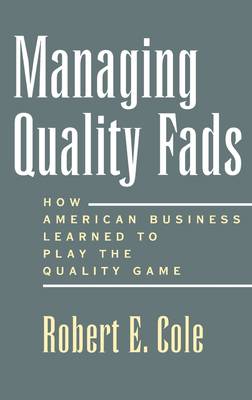
Can managers learn from fads? That is the question Robert Cole addresses in this insightful book about the various factors supporting and inhibiting organizational learning. A longtime student of the Japanese and American quality movements, Cole focuses on the response of American industry to the challenge posed in the early 1980s by high quality goods from Japan. While most American managers view this challenge as slowly but successfully met, many academics see the quality movement that emerged from it as just another fad. In seeking to reconcile these two views, Cole explores the reasons behind American industry's slow response to Japanese quality, arguing that a variety of institutional factors inhibited management action in the early 1980s. He then describes the reshaping of institutions that allowed American companies to close the quality gap and to achieve sustained quality improvements in the 1990s. Hewlett-Packard serves as an example of a company that made this institutional transition more effectively than most. Cole describes Hewlett-Packard's successful strategies while also pointing out the serious problems that it and other companies face as they attempt to adapt, improve, and go beyond Japanese practices. He also uses Hewlett-Packard, an exemplar of the highly decentralized company, to explore effective strategies for the creation, dissemination, and implementation of knowledge. Unprecedented as a scholarly treatment of the quality movement, ^IManaging Quality Fads^R provides several important lessons for those interested in management decision making under conditions of uncertainty and organizational transformation in a rapidly changing business environment.
Specificaties
Betrokkenen
- Auteur(s):
- Uitgeverij:
Inhoud
- Aantal bladzijden:
- 304
- Taal:
- Engels
Eigenschappen
- Productcode (EAN):
- 9780195122602
- Verschijningsdatum:
- 4/02/1999
- Uitvoering:
- Hardcover
- Formaat:
- Genaaid
- Afmetingen:
- 162 mm x 239 mm
- Gewicht:
- 580 g


Alleen bij Standaard Boekhandel
+ 457 punten op je klantenkaart van Standaard Boekhandel
CADEAU

AANGERADEN


Beoordelingen
We publiceren alleen reviews die voldoen aan de voorwaarden voor reviews. Bekijk onze voorwaarden voor reviews.