


- Afhalen na 1 uur in een winkel met voorraad
- Gratis thuislevering in België vanaf € 30
- Ruim aanbod met 7 miljoen producten
- Afhalen na 1 uur in een winkel met voorraad
- Gratis thuislevering in België vanaf € 30
- Ruim aanbod met 7 miljoen producten





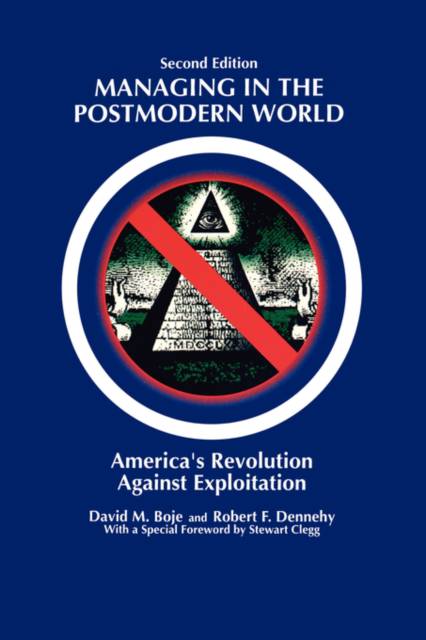
Managing in the Postmodern World
America's Revolution Against Exploitation
David M Boje, Robert F Dennehy
Paperback | Engels
€ 70,95
+ 141 punten
Omschrijving
The book suggests that these postmodern times may well pass by America, that it will be stymied by the legacies of a post-industrialism in which a form of power/knowledge was institutionalized in corporate embodiments swollen with the bureaucratized complacency that defense-related contracting induced in organizations remote from competitive struggle in a consumer market-place. It is now clear that the post-industrial society was a knowledge-based society shaped by the requirements of the Cold War and the warfare state. It was these which materialized the shift in organizational social relations from an industrial epoch founded on exploitation to one in which value became increasingly fused within the unity of power/knowledge condensed within the global, bureaucratic, corporate frame. America won the Cold War but is clearly in danger of losing the aftermath, not to the old adversaries, but to nations which were not even admitted to the Cold War game as equal players: most noticeably Japan, but also Germany, the powerhouse at the center of the European Community, as well as the Newly-Industrializing Countries of East Asia. Statutorily, of course, the first two were not allowed to, play as part of the Cold War settlement at Yalta. Exclusion spawned different strategies premised on structures which were and had always been institution ally distinct. What is to be done? Boje and Dennehy are quite clear: first, there has to be a realization that the recipes of modernism were epoch or era specific and may be past their use-by date in some areas of organizational life. Second, that for as long as the lenses through which we focus on organizational life are made to modernist specifications, so that they focus on variables such as formalization, standardization, centralization, etc., as the strategic focus for research and teaching, we will be condemned to doing the 'time-warp' over and over again, stuck in the modernist frame while the spectacle outside turns ever more postmodern. Third, that postmodernism offers an integrative focus which will aid us as teachers, students, researchers and practitioners in overcoming the excessive differentiation which has fragmented our intellectual and praxeological communities. Fourth, that in doing so it will serve to re-vitalize the study of management and organizations by opening it up to the cutting-edge of contemporary social science currents. If the hypotheses and argument that the authors advance are substantially correct, then we stand at one of those moments in history when the urge to resist and understand the limitations of the old slogans is critical. America's Revolution Against Exploitation: The Story of Postmodern Management achieves this resistance and this understanding sufficiently to reconfigure our grasp of the modern condition in which we have been while pointing us towards what we may become. One should salute the book as a contribution to one of the projects for the future, one which, because of its easy style, deserves to secure postmodernism a good name in management and organization theory circles.
Specificaties
Betrokkenen
- Auteur(s):
- Uitgeverij:
Inhoud
- Aantal bladzijden:
- 384
- Taal:
- Engels
Eigenschappen
- Productcode (EAN):
- 9781593119164
- Verschijningsdatum:
- 21/03/2008
- Uitvoering:
- Paperback
- Formaat:
- Trade paperback (VS)
- Afmetingen:
- 156 mm x 234 mm
- Gewicht:
- 535 g



Alleen bij Standaard Boekhandel
+ 141 punten op je klantenkaart van Standaard Boekhandel
Cadeau

AANGERADEN


Beoordelingen
We publiceren alleen reviews die voldoen aan de voorwaarden voor reviews. Bekijk onze voorwaarden voor reviews.