


- Afhalen na 1 uur in een winkel met voorraad
- Gratis thuislevering in België vanaf € 30
- Ruim aanbod met 7 miljoen producten
- Afhalen na 1 uur in een winkel met voorraad
- Gratis thuislevering in België vanaf € 30
- Ruim aanbod met 7 miljoen producten





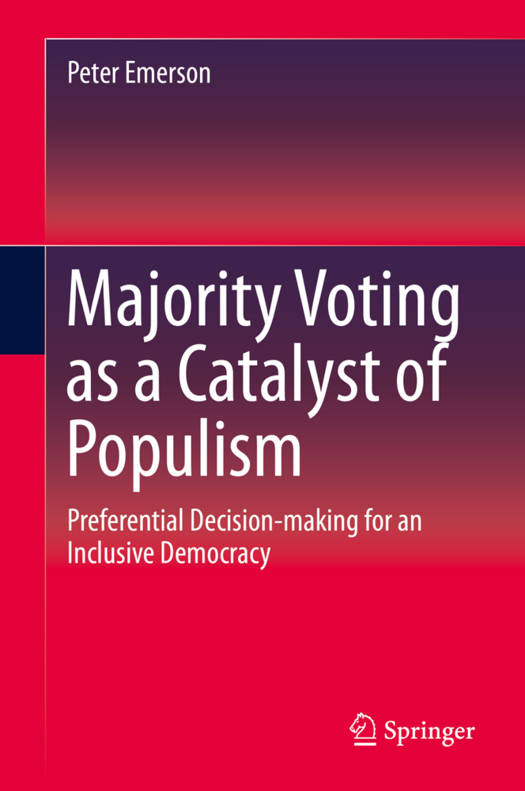
Majority Voting as a Catalyst of Populism
Preferential Decision-Making for an Inclusive Democracy
Peter Emerson
Hardcover | Engels
€ 90,95
+ 181 punten
Uitvoering
Omschrijving
This timely book presents a critique of binary majority rule and provides insights into why, in many instances, the outcome of a two-option ballot does not accurately reflect the will of the people. Based on the author's first-hand experience, majority-voting is argued to be a catalyst of populism and its divisive outcomes have prompted countless disputes throughout Europe and Asia. In like manner, simple majority rule is seen as a cause of conflict in war zones, and of dysfunction in so-called stable democracies. In order to safeguard democracy, an all-party power-sharing approach is proposed, which would make populism less attractive to voters and governments alike. In geographically arranged chapters, well-tested alternative voting procedures (e. g. non-majoritarian Modified Borda Count) are presented in case studies of Northern Ireland, Central Europe, the Balkans, the Caucasus, Russia, China, North Korea and Mongolia.
Specificaties
Betrokkenen
- Auteur(s):
- Uitgeverij:
Inhoud
- Aantal bladzijden:
- 227
- Taal:
- Engels
Eigenschappen
- Productcode (EAN):
- 9783030202187
- Verschijningsdatum:
- 8/10/2019
- Uitvoering:
- Hardcover
- Formaat:
- Genaaid
- Afmetingen:
- 156 mm x 234 mm
- Gewicht:
- 553 g


Alleen bij Standaard Boekhandel
+ 181 punten op je klantenkaart van Standaard Boekhandel
AANGERADEN


Beoordelingen
We publiceren alleen reviews die voldoen aan de voorwaarden voor reviews. Bekijk onze voorwaarden voor reviews.