


- Afhalen na 1 uur in een winkel met voorraad
- Gratis thuislevering in België vanaf € 30
- Ruim aanbod met 7 miljoen producten
- Afhalen na 1 uur in een winkel met voorraad
- Gratis thuislevering in België vanaf € 30
- Ruim aanbod met 7 miljoen producten





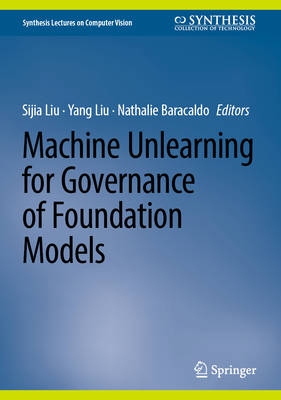
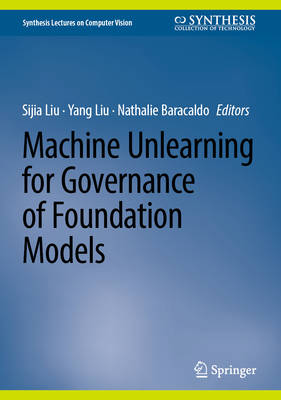
Machine Unlearning for Governance of Foundation Models
€ 42,95
+ 85 punten
Omschrijving
This book provides a systematic and in-depth introduction to machine unlearning (MU) for foundation models, framed through an optimization-model-data tri-design perspective and complemented by assessments and applications. As foundation models are continuously adapted and reused, the ability to selectively remove unwanted data, knowledge, or model behavior, without full retraining, poses new theoretical and practical challenges. Thus, MU has become a critical capability for trustworthy, deployable, and regulation-ready artificial intelligence. From the optimization viewpoint, this book treats unlearning as a multi-objective and often adversarial problem that must simultaneously enforce targeted forgetting, preserve model utility, resist recovery attacks, and remain computationally efficient. From the model perspective, the book examines how knowledge is distributed across layers and latent subspaces, motivating modular and localized unlearning. From the data perspective, the book explores forget-set construction, data attribution, corruption, and coresets as key drivers of reliable forgetting. Bridging theory and practice, the book also provides a comprehensive review of benchmark datasets and evaluation metrics for machine unlearning, critically examining their strengths and limitations. The authors further survey a wide range of applications in computer vision and large language models, including AI safety, privacy, fairness, and industrial deployment, highlighting why post-training model modification is often preferred over repeated retraining in real-world systems. By unifying optimization, model, data, evaluation, and application perspectives, this book offers both a foundational framework and a practical toolkit for designing machine unlearning methods that are effective, robust, and ready for large-scale, regulated deployment.
Specificaties
Betrokkenen
- Uitgeverij:
Inhoud
- Aantal bladzijden:
- 264
- Taal:
- Engels
- Reeks:
Eigenschappen
- Productcode (EAN):
- 9783032172815
- Verschijningsdatum:
- 19/05/2026
- Uitvoering:
- Hardcover
- Formaat:
- Genaaid
- Afmetingen:
- 168 mm x 240 mm

Alleen bij Standaard Boekhandel
+ 85 punten op je klantenkaart van Standaard Boekhandel
Cadeau

AANGERADEN


Beoordelingen
We publiceren alleen reviews die voldoen aan de voorwaarden voor reviews. Bekijk onze voorwaarden voor reviews.