


- Afhalen na 1 uur in een winkel met voorraad
- Gratis thuislevering in België vanaf € 30
- Ruim aanbod met 7 miljoen producten
- Afhalen na 1 uur in een winkel met voorraad
- Gratis thuislevering in België vanaf € 30
- Ruim aanbod met 7 miljoen producten





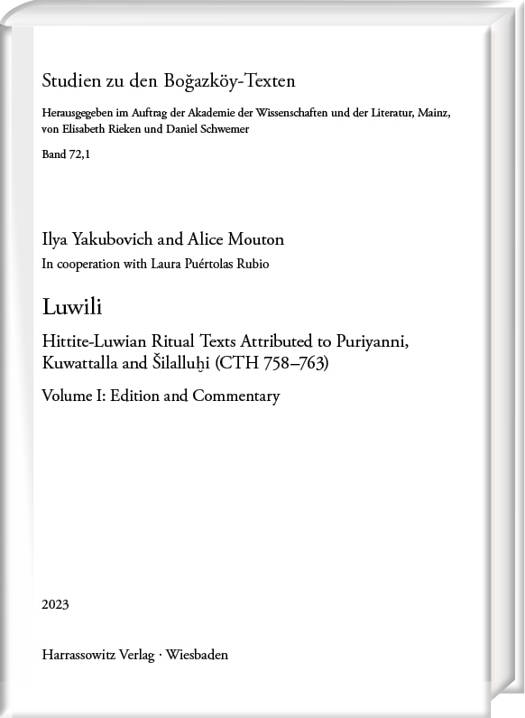
Luwili
Hittite-Luwian Ritual Texts Attributed to Puriyanni, Kuwattalla and Silalluhi (Cth 758-763). Volume I: Edition and Commentary. Volume II: Discussion and Glossary
Alice Mouton, Ilya Yakubovich
€ 175,45
+ 350 punten
Omschrijving
The Luwian language belongs to the Anatolian group of the Indo-European language family and thus constitutes a close relative of Hittite. As a rule, the Luwian cuneiform passages represent incantations embedded in Hittite religious texts. Although their full corpus was published in the twentieth century, no attempts at their cohesive philological translation has been undertaken up to now. The volume Luwili: Hittite-Luwian ritual texts attributed to Puriyanni, Kuwattalla, and silalluhi (CTH 758-763) represents the first step toward achieving this goal. Ilya Yakubovich and Alice Mouton, two Hittitologists specializing in Luwian Studies and Anatolian ritualistic traditions respectively, joined efforts in order to approach the Hittite-Luwian rituals from both linguistic and anthropological perspectives. The rituals that they have edited there contain more than fifty percent of the Luwian cuneiform corpus. Their research contributes to two different fields: first, it helps the scholarly community to understand better the Luwian language, second, it impacts the study of Anatolian religions. The authors attempted to avoid the technical jargon in as much as possible, while the layout of the edition, where the transliteration and translation are aligned with each other on two symmetrical pages, should facilitate its reading.
Specificaties
Betrokkenen
- Auteur(s):
- Uitgeverij:
Inhoud
- Aantal bladzijden:
- 974
- Taal:
- Engels
- Reeks:
- Reeksnummer:
- nr. 72
Eigenschappen
- Productcode (EAN):
- 9783447119955
- Verschijningsdatum:
- 23/08/2023
- Uitvoering:
- Hardcover
- Formaat:
- Genaaid
- Afmetingen:
- 182 mm x 65 mm
- Gewicht:
- 190 g


Alleen bij Standaard Boekhandel
+ 350 punten op je klantenkaart van Standaard Boekhandel
Cadeau

AANGERADEN


Beoordelingen
We publiceren alleen reviews die voldoen aan de voorwaarden voor reviews. Bekijk onze voorwaarden voor reviews.