



Je cadeautjes zeker op tijd in huis hebben voor de feestdagen? Kom langs in onze winkels en vind het perfecte geschenk!
- Afhalen na 1 uur in een winkel met voorraad
- Gratis thuislevering in België vanaf € 30
- Ruim aanbod met 7 miljoen producten
Je cadeautjes zeker op tijd in huis hebben voor de feestdagen? Kom langs in onze winkels en vind het perfecte geschenk!
- Afhalen na 1 uur in een winkel met voorraad
- Gratis thuislevering in België vanaf € 30
- Ruim aanbod met 7 miljoen producten





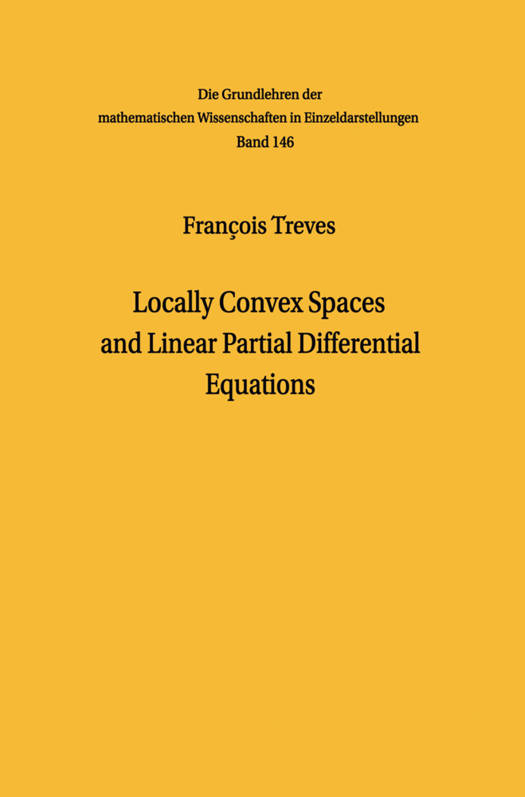
Locally Convex Spaces and Linear Partial Differential Equations
François Treves
€ 103,45
+ 206 punten
Omschrijving
It is hardly an exaggeration to say that, if the study of general topolog- ical vector spaces is justified at all, it is because of the needs of distribu- tion and Linear PDE * theories (to which one may add the theory of convolution in spaces of hoi om orphic functions). The theorems based on TVS ** theory are generally of the "foundation" type: they will often be statements of equivalence between, say, the existence - or the approx- imability -of solutions to an equation Pu = v, and certain more "formal" properties of the differential operator P, for example that P be elliptic or hyperboJic, together with properties of the manifold X on which P is defined. The latter are generally geometric or topological, e. g. that X be P-convex (Definition 20. 1). Also, naturally, suitable conditions will have to be imposed upon the data, the v's, and upon the stock of possible solutions u. The effect of such theorems is to subdivide the study of an equation like Pu = v into two quite different stages. In the first stage, we shall look for the relevant equivalences, and if none is already available in the literature, we shall try to establish them. The second stage will consist of checking if the "formal" or "geometric" conditions are satisfied.
Specificaties
Betrokkenen
- Auteur(s):
- Uitgeverij:
Inhoud
- Aantal bladzijden:
- 123
- Taal:
- Engels
- Reeks:
- Reeksnummer:
- nr. 146
Eigenschappen
- Productcode (EAN):
- 9783642873737
- Verschijningsdatum:
- 21/04/2012
- Uitvoering:
- Paperback
- Formaat:
- Trade paperback (VS)
- Afmetingen:
- 156 mm x 234 mm
- Gewicht:
- 204 g


Alleen bij Standaard Boekhandel
+ 206 punten op je klantenkaart van Standaard Boekhandel
CADEAU


Beoordelingen
We publiceren alleen reviews die voldoen aan de voorwaarden voor reviews. Bekijk onze voorwaarden voor reviews.