



Je cadeautjes zeker op tijd in huis hebben voor de feestdagen? Kom langs in onze winkels en vind het perfecte geschenk!
- Afhalen na 1 uur in een winkel met voorraad
- Gratis thuislevering in België vanaf € 30
- Ruim aanbod met 7 miljoen producten
Je cadeautjes zeker op tijd in huis hebben voor de feestdagen? Kom langs in onze winkels en vind het perfecte geschenk!
- Afhalen na 1 uur in een winkel met voorraad
- Gratis thuislevering in België vanaf € 30
- Ruim aanbod met 7 miljoen producten





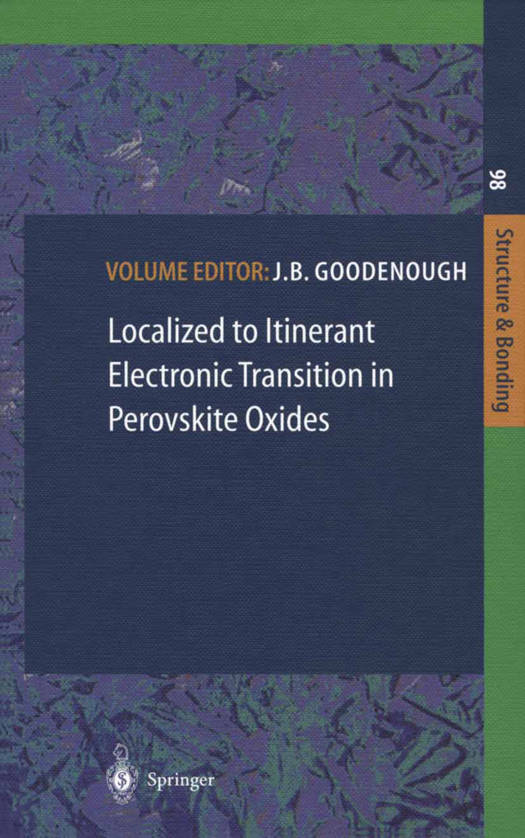
Localized to Itinerant Electronic Transition in Perovskite Oxides
€ 503,95
+ 1007 punten
Omschrijving
Interest in the transition metal oxides with perovskite related structures goes back to the 1950s when the sodium tungsten bronzes NaxWO3 were shown to be metallic [1 ], the system Lal_xSr MnO3 was found to contain a ferromagnetic conductive phase [2], and La0.sSr0.sCoO3 was reported to be a ferromagnetic metal, but with a peculiar magnetization of 1.5 #a/Co atom [3]. Stoichiometric oxide perovskites have the generic formula AMO3 in which the A site is at the center of a simple cubic array of M sites; the oxide ions form (180 ° 4)) M O M bridges to give an MO3 array of corner shared MO6/2 octahedra and the larger A cations have twelvefold oxygen coordination. Mismatch between the A O and M O equilibrium bond lengths introduces internal stresses. A compressive stress on the MO3 array is accommodated by a lowering of the M O M bond angle from 180 ° to (180 ° 4)); a tensile stress on the M O M bonds is accommodated by the formation of hexagonal polytypes [4].
Specificaties
Betrokkenen
- Uitgeverij:
Inhoud
- Aantal bladzijden:
- 239
- Taal:
- Engels
- Reeks:
- Reeksnummer:
- nr. 98
Eigenschappen
- Productcode (EAN):
- 9783642086960
- Verschijningsdatum:
- 7/12/2010
- Uitvoering:
- Paperback
- Formaat:
- Trade paperback (VS)
- Afmetingen:
- 156 mm x 234 mm
- Gewicht:
- 362 g

Alleen bij Standaard Boekhandel
+ 1007 punten op je klantenkaart van Standaard Boekhandel
CADEAU


Beoordelingen
We publiceren alleen reviews die voldoen aan de voorwaarden voor reviews. Bekijk onze voorwaarden voor reviews.