


- Afhalen na 1 uur in een winkel met voorraad
- Gratis thuislevering in België vanaf € 30
- Ruim aanbod met 7 miljoen producten
- Afhalen na 1 uur in een winkel met voorraad
- Gratis thuislevering in België vanaf € 30
- Ruim aanbod met 7 miljoen producten





Omschrijving
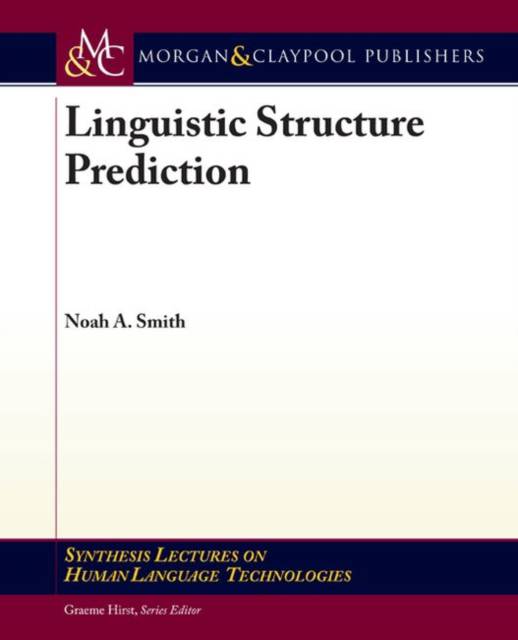
A major part of natural language processing now depends on the use of text data to build linguistic analyzers. We consider statistical, computational approaches to modeling linguistic structure. We seek to unify across many approaches and many kinds of linguistic structures. Assuming a basic understanding of natural language processing and/or machine learning, we seek to bridge the gap between the two fields. Approaches to decoding (i.e., carrying out linguistic structure prediction) and supervised and unsupervised learning of models that predict discrete structures as outputs are the focus. We also survey natural language processing problems to which these methods are being applied, and we address related topics in probabilistic inference, optimization, and experimental methodology. Table of Contents: Representations and Linguistic Data / Decoding: Making Predictions / Learning Structure from Annotated Data / Learning Structure from Incomplete Data / Beyond Decoding: Inference
Specificaties
Betrokkenen
- Auteur(s):
- Uitgeverij:
Inhoud
- Aantal bladzijden:
- 270
- Taal:
- Engels
- Reeks:
Eigenschappen
- Productcode (EAN):
- 9781608454051
- Verschijningsdatum:
- 3/06/2011
- Uitvoering:
- Paperback
- Formaat:
- Trade paperback (VS)
- Afmetingen:
- 191 mm x 235 mm
- Gewicht:
- 467 g



Alleen bij Standaard Boekhandel
+ 183 punten op je klantenkaart van Standaard Boekhandel
Cadeau

AANGERADEN


Beoordelingen
We publiceren alleen reviews die voldoen aan de voorwaarden voor reviews. Bekijk onze voorwaarden voor reviews.