



Je cadeautjes zeker op tijd in huis hebben voor de feestdagen? Kom langs in onze winkels en vind het perfecte geschenk!
- Afhalen na 1 uur in een winkel met voorraad
- Gratis thuislevering in België vanaf € 30
- Ruim aanbod met 7 miljoen producten
Je cadeautjes zeker op tijd in huis hebben voor de feestdagen? Kom langs in onze winkels en vind het perfecte geschenk!
- Afhalen na 1 uur in een winkel met voorraad
- Gratis thuislevering in België vanaf € 30
- Ruim aanbod met 7 miljoen producten





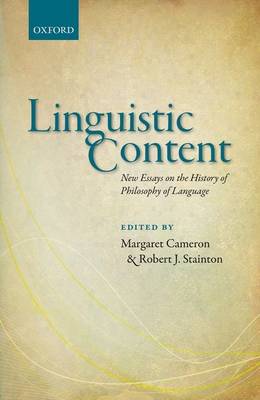
Linguistic Content
New Essays on the History of Philosophy of Language
Margaret Cameron
Hardcover | Engels
€ 169,45
+ 338 punten
Omschrijving
Philosophy of language has a rich and varied history stretching back to the Ancient Greeks. Twelve specially written essays explore this richness, from Plato and Aristotle, through the Stoics, to medieval thinkers, both Islamic and Christian; from the Renaissance and the early modern period, all the way up to the twentieth Century. Among the many topics that arise across this 2500-year trajectory are metaphysical questions about linguistic content. A first focal point of the volume is the issue of which broad ontological family linguistic contents belong to. Are linguistic contents mental ideas, physical particulars, abstract Forms, social practices, or something else again? And do different sorts of linguistic contents belong to different ontological categories-e.g., might it be that names stand for ideas, whereas logical terms stand for mental processes? The second focal point is the metaphysical grounding of linguistic content: that is, in virtue of what more basic facts do content facts obtain? Do words mean what they do because of natural resemblances? Because of causal relations? Because of arbitrary conventional usage? Or because of some combination of the above?
Specificaties
Betrokkenen
- Auteur(s):
- Uitgeverij:
Inhoud
- Aantal bladzijden:
- 282
- Taal:
- Engels
Eigenschappen
- Productcode (EAN):
- 9780198732495
- Verschijningsdatum:
- 19/05/2015
- Uitvoering:
- Hardcover
- Formaat:
- Genaaid
- Afmetingen:
- 157 mm x 234 mm
- Gewicht:
- 521 g


Alleen bij Standaard Boekhandel
+ 338 punten op je klantenkaart van Standaard Boekhandel
CADEAU


Beoordelingen
We publiceren alleen reviews die voldoen aan de voorwaarden voor reviews. Bekijk onze voorwaarden voor reviews.