


- Afhalen na 1 uur in een winkel met voorraad
- Gratis thuislevering in België vanaf € 30
- Ruim aanbod met 7 miljoen producten
- Afhalen na 1 uur in een winkel met voorraad
- Gratis thuislevering in België vanaf € 30
- Ruim aanbod met 7 miljoen producten





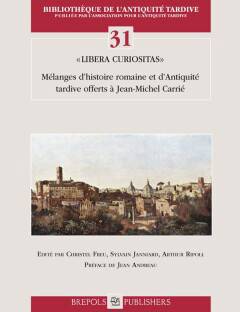
Libera curiositas. Mélanges d'histoire romaine et d'Antiquité tardive offerts à Jean-Michel Carrié
Melanges d'Histoire Romaine Et d'Antiquite Tardive Offerts a Jean-Michel Carrie
Christel Freu
€ 116,60
+ 233 punten
Omschrijving
During a career that led him from Paris X to the EHESS, Jean-Michel Carrie profoundly enriched our knowledge of Late Antiquity, to which he dedicated the largest part of his works. In his detailed articles as in his syntheses, he gave a documented and balanced appreciation of the Late Roman Empire, through a combined examination of various sources, particularly papyrus and imperial constitutions. His work shed new and fertile light on large parts of the structures of the Late Roman State: the administration and its tax system, with their impact on the Roman society, or the defence of the Empire, its methods and means, to mention only the main domains which he illustrated. With this volume, the editors wished to pay a due tribute to Jean-Michel Carrie's scientific and human libera curiositas: a free curiosity variously experienced by the forty contributors of these Melanges, as colleagues, friends, readers or students. The studies collected in the volume cover the main fields explored by Jean-Michel Carrie, first of all the tax system and the Late Roman army, its foreign auxiliaries as its Egyptian garrisons. Secondly, the Roman frontier policy is studied through the questions of diplomatic exchanges, alliances and federates' recruitment. In the third part, the contributions dedicated to the regional societies and economies reflect the geographical extent of the scientific interests of Jean-Michel Carrie, from Britain to Syria, through Italy and Egypt. A tribute is also given to its method in the interpretation of the literary sources, such as the Latin Panegyrics, the Res Gestae of Ammianus, the Historia Augusta, the speeches of Libanios and Procopius' Wars. Finally, the last part of the volume is dedicated to the Christianisation of the Late Roman State and Society.
Specificaties
Betrokkenen
- Auteur(s):
- Uitgeverij:
Inhoud
- Aantal bladzijden:
- 498
- Taal:
- Frans
- Reeks:
- Reeksnummer:
- nr. 31
Eigenschappen
- Productcode (EAN):
- 9782503566757
- Verschijningsdatum:
- 14/11/2016
- Uitvoering:
- Paperback
- Formaat:
- Trade paperback (VS)
- Afmetingen:
- 211 mm x 277 mm
- Gewicht:
- 1814 g


Alleen bij Standaard Boekhandel
+ 233 punten op je klantenkaart van Standaard Boekhandel
Cadeau

AANGERADEN


Beoordelingen
We publiceren alleen reviews die voldoen aan de voorwaarden voor reviews. Bekijk onze voorwaarden voor reviews.