


- Afhalen na 1 uur in een winkel met voorraad
- Gratis thuislevering in België vanaf € 30
- Ruim aanbod met 7 miljoen producten
- Afhalen na 1 uur in een winkel met voorraad
- Gratis thuislevering in België vanaf € 30
- Ruim aanbod met 7 miljoen producten





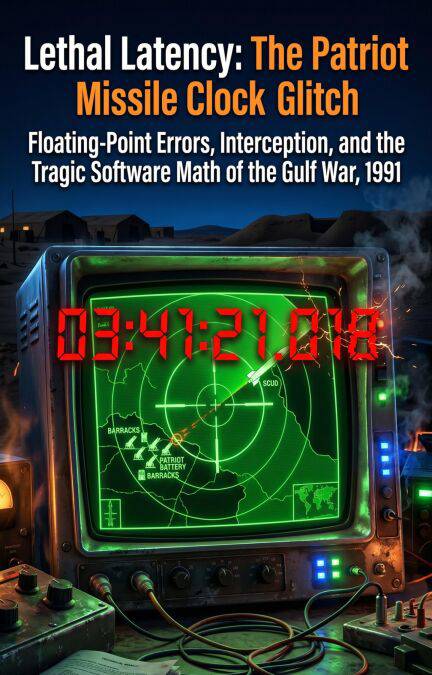
Lethal Latency: The Patriot Missile Clock Glitch E-BOOK
Floating-Point Errors, Interception, and the Tragic Software Math of the Gulf War, 1991
Steven Long
E-book | Engels
€ 4,99
+ 4 punten
Omschrijving
How can the most sophisticated anti-missile defense system in the United States military completely fail to intercept an incoming, outdated Scud missile, resulting in the tragic deaths of 28 American soldiers? The failure of the Patriot Missile battery in Dhahran, Saudi Arabia, during the 1991 Gulf War, was caused entirely by a microscopic, accumulating mathematical rounding error.
The Patriot's radar system calculated the speed of incoming missiles using an internal clock that measured time in tenths of a second. However, the system's 24-bit computer register could not store the fraction 1/10 perfectly, resulting in a tiny floating-point truncation error. While insignificant during a short test run, this specific battery had been left powered on continuously for 100 hours. The microscopic error compounded over time, causing the system's internal clock to drift by just 0.34 seconds. For a Scud missile traveling at Mach 5, that 0.34-second delay translated to a tracking error of over half a kilometer. The system looked in the wrong place, ignored the missile, and let it strike the barracks.
This precise forensic engineering study deconstructs the intersection of military hardware and software limits. It explores the difficulty of floating-point math in binary, the tragic delays in patching the software, and the brutal reality of digital drift.
Time is relative, but math is absolute. The Patriot Missile glitch proves that in high-stakes programming, the smallest fraction of an approximation can effortlessly cost human lives.
The Patriot's radar system calculated the speed of incoming missiles using an internal clock that measured time in tenths of a second. However, the system's 24-bit computer register could not store the fraction 1/10 perfectly, resulting in a tiny floating-point truncation error. While insignificant during a short test run, this specific battery had been left powered on continuously for 100 hours. The microscopic error compounded over time, causing the system's internal clock to drift by just 0.34 seconds. For a Scud missile traveling at Mach 5, that 0.34-second delay translated to a tracking error of over half a kilometer. The system looked in the wrong place, ignored the missile, and let it strike the barracks.
This precise forensic engineering study deconstructs the intersection of military hardware and software limits. It explores the difficulty of floating-point math in binary, the tragic delays in patching the software, and the brutal reality of digital drift.
Time is relative, but math is absolute. The Patriot Missile glitch proves that in high-stakes programming, the smallest fraction of an approximation can effortlessly cost human lives.
Specificaties
Betrokkenen
- Auteur(s):
- Uitgeverij:
Inhoud
- Aantal bladzijden:
- 220
- Taal:
- Engels
Eigenschappen
- Productcode (EAN):
- 9783565463862
- Verschijningsdatum:
- 26/05/2026
- Uitvoering:
- E-book
- Formaat:
- ePub


Alleen bij Standaard Boekhandel
+ 4 punten op je klantenkaart van Standaard Boekhandel
Cadeau

AANGERADEN


Beoordelingen
We publiceren alleen reviews die voldoen aan de voorwaarden voor reviews. Bekijk onze voorwaarden voor reviews.