


- Afhalen na 1 uur in een winkel met voorraad
- Gratis thuislevering in België vanaf € 30
- Ruim aanbod met 7 miljoen producten
- Afhalen na 1 uur in een winkel met voorraad
- Gratis thuislevering in België vanaf € 30
- Ruim aanbod met 7 miljoen producten





€ 75,95
+ 151 punten
Omschrijving
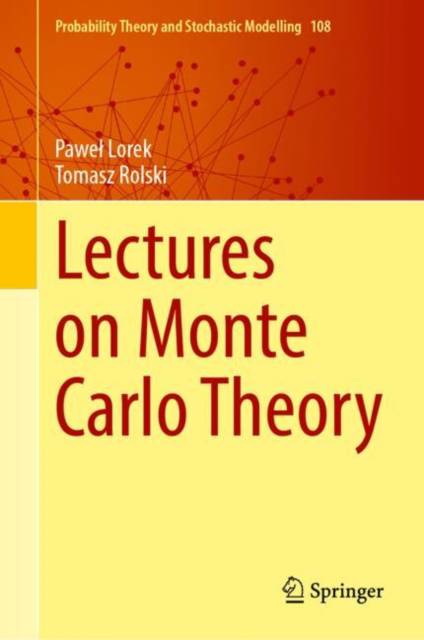
This book presents a broad range of computational techniques based on repeated random sampling, widely known as Monte Carlo methods and sometimes as stochastic simulation. These methods bring together ideas from probability theory, statistics, computer science, and statistical physics, providing tools for solving problems in fields such as operations research, biotechnology, and finance. Topics include the generation and analysis of pseudorandom numbers (which are intended to imitate truly random numbers on a computer), the design and justification of Monte Carlo algorithms, and advanced approaches such as Markov chain Monte Carlo and stochastic optimization. In contrast to deterministic numerical methods, the outcome of a Monte Carlo algorithm is itself random - and one needs the tools of probability and statistics to interpret these results meaningfully. The theoretical foundations, particularly the law of large numbers and central limit theorem, are combined with practical algorithms that reveal both the strengths and subtleties of stochastic simulation. The book includes numerous exercises, both theoretical and computational. Each chapter features step-by-step algorithms, illustrated examples, and results presented through numerical computations, tables, and a variety of plots and figures. All Python code used to produce these results is publicly available, allowing readers to reproduce and explore simulations on their own. Intended primarily for graduate students and researchers, the exposition focuses on core concepts and intuitive understanding, avoiding excessive formalism. The book is suitable both for self-study and as a course text and offers a clear pathway from foundational principles to modern applications.
Specificaties
Betrokkenen
- Auteur(s):
- Uitgeverij:
Inhoud
- Aantal bladzijden:
- 632
- Taal:
- Engels
- Reeks:
- Reeksnummer:
- nr. 108
Eigenschappen
- Productcode (EAN):
- 9783032011893
- Verschijningsdatum:
- 26/10/2025
- Uitvoering:
- Hardcover
- Formaat:
- Genaaid
- Afmetingen:
- 156 mm x 234 mm
- Gewicht:
- 1079 g


Alleen bij Standaard Boekhandel
+ 151 punten op je klantenkaart van Standaard Boekhandel
Cadeau

AANGERADEN


Beoordelingen
We publiceren alleen reviews die voldoen aan de voorwaarden voor reviews. Bekijk onze voorwaarden voor reviews.