Standaard Boekhandel gebruikt cookies en gelijkaardige technologieën om de website goed te laten werken en je een betere surfervaring te bezorgen.
Hieronder kan je kiezen welke cookies je wilt inschakelen:
Technische en functionele cookies
Deze cookies zijn essentieel om de website goed te laten functioneren, en laten je toe om bijvoorbeeld in te loggen. Je kan deze cookies niet uitschakelen.
Analytische cookies
Deze cookies verzamelen anonieme informatie over het gebruik van onze website. Op die manier kunnen we de website beter afstemmen op de behoeften van de gebruikers.
Marketingcookies
Deze cookies delen je gedrag op onze website met externe partijen, zodat je op externe platformen relevantere advertenties van Standaard Boekhandel te zien krijgt.
Je kan maximaal 250 producten tegelijk aan je winkelmandje toevoegen. Verwijdere enkele producten uit je winkelmandje, of splits je bestelling op in meerdere bestellingen.
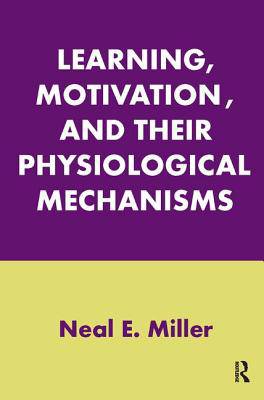
Neal E. Miller's pioneering work in experimental psychology has earned him worldwide respect. This second in a two-volume collection of his work brings together forty-three of Miller's most important and representative essays on learning, motivation, and their physiological mechanisms. They were selected on the basis of their current relevance and their historical significance at the time they were published. In order to emphasize the main themes, essays on a given topic have been grouped together.Learning, Motivation, and Their Physiological Mechanisms begins when the author first discovered the thrill of designing and executing experiments to get clear-cut answers concerning the behavior of children and of rats. The first study was one of the earliest ones on the behavioral effects of the recently synthesized male hormone, testosterone. The second was one of the earliest studies demonstrating the value of using a variety of behavioral techniques to investigate the motivational effects of a physiological intervention. The next studies investigated the satisfying and rewarding effects of food or water in the stomach versus in the mouth and the thirst-inducing and reducing effects of hyper- and hypotonic solutions, respectively, injected into the brain. The last study describes a technique devised for extending the analysis of the mechanism of hunger to the effects of humoral factors in the blood.The study is completed with an examination of trial-and-error learning that was motivated by direct electrical stimulation of the brain and rewarded by the termination of such stimulation. Other studies show that the stimulation via such electrodes not only elicits eating, but also has the principal motivational characteristics of normal hunger. The conclusion deals with a series of experiments that overthrows strong traditional beliefs by proving that glandular and visceral responses mediated by the autonomic nervous system are subject to instrumental learning, which can be made quite specific.