


- Afhalen na 1 uur in een winkel met voorraad
- Gratis thuislevering in België vanaf € 30
- Ruim aanbod met 7 miljoen producten
- Afhalen na 1 uur in een winkel met voorraad
- Gratis thuislevering in België vanaf € 30
- Ruim aanbod met 7 miljoen producten




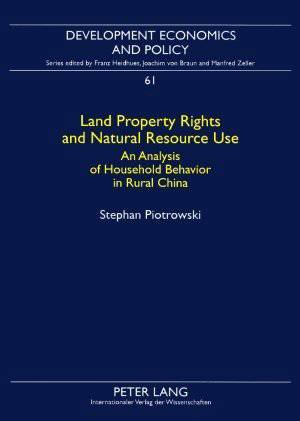
Land Property Rights and Natural Resource Use
An Analysis of Household Behavior in Rural China
Stephan Piotrowski
€ 73,45
+ 146 punten
Omschrijving
The general objective of this volume is to assess the effects of China's rural land property system on land allocation and land use. For almost 30 years, farmers have individual land use rights, but a number of problems remain. Land reallocations cause tenure insecurity and an underinvestment in land. Land use rights are not allowed to be used as collateral for accessing credit. Furthermore, women are discriminated in the land allocation process. These issues are analyzed at the household as well as the village level. The results show that there exists significant heterogeneity rather than a uniform tenure system. The emerging land rental market can mitigate some of the defects of the land tenure system, but there exist administrative restrictions as well as information deficits which should be overcome by suitable institutional innovations.
Specificaties
Betrokkenen
- Auteur(s):
- Uitgeverij:
Inhoud
- Aantal bladzijden:
- 166
- Taal:
- Engels
- Reeks:
- Reeksnummer:
- nr. 61
Eigenschappen
- Productcode (EAN):
- 9783631591437
- Verschijningsdatum:
- 3/03/2009
- Uitvoering:
- Paperback
- Formaat:
- Trade paperback (VS)
- Afmetingen:
- 148 mm x 210 mm
- Gewicht:
- 269 g


Alleen bij Standaard Boekhandel
+ 146 punten op je klantenkaart van Standaard Boekhandel
AANGERADEN


Beoordelingen
We publiceren alleen reviews die voldoen aan de voorwaarden voor reviews. Bekijk onze voorwaarden voor reviews.