


- Afhalen na 1 uur in een winkel met voorraad
- Gratis thuislevering in België vanaf € 30
- Ruim aanbod met 7 miljoen producten
- Afhalen na 1 uur in een winkel met voorraad
- Gratis thuislevering in België vanaf € 30
- Ruim aanbod met 7 miljoen producten





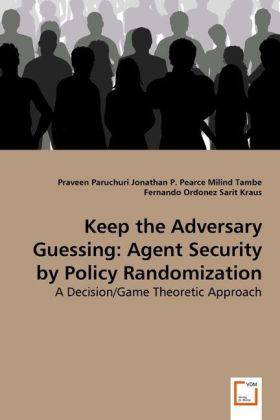
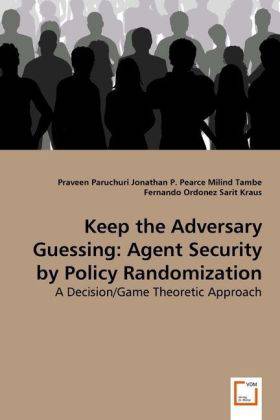
Keep the Adversary Guessing
Agent Security by Policy Randomization
Praveen Paruchuri, Jonathan P Pearce, Milind Tambe
Paperback | Engels
€ 71,95
+ 143 punten
Omschrijving
This book is devoted to the development of efficient algorithms for enhancing security of Multiagent systems deployed in real world. In particular, we present here algorithms developed using the Decision/Game Theoretic frameworks. Our algorithms can be classified into two kinds: First, when the agent has no model of its adversaries, the key idea is to randomize the policy of the agent to minimize the information given out. To that end, we present policy randomization algorithms developed using the MDP/Dec-POMDP frameworks. Second, when the agent has partial model of its adversaries, we model the security domain as a Bayesian Stackelberg game. Given the NP-hardness result to find the optimal solution, we provide efficient MILP based approaches to obtain significant speedups. The technology presented here has initiated and became heart of the ARMOR (Assistant for Randomized Monitoring over Routes) security scheduler, currently deployed at the Los Angeles International Airport (LAX) since August-07. Given the general purpose nature of our algorithms, they can potentially be used for enhancing security at many other major locations such as airports, dams, museums, stadiums and others.
Specificaties
Betrokkenen
- Auteur(s):
- Uitgeverij:
Inhoud
- Aantal bladzijden:
- 120
- Taal:
- Engels
Eigenschappen
- Productcode (EAN):
- 9783639019254
- Verschijningsdatum:
- 23/06/2008
- Uitvoering:
- Paperback
- Formaat:
- Trade paperback (VS)
- Afmetingen:
- 152 mm x 229 mm
- Gewicht:
- 172 g


Alleen bij Standaard Boekhandel
+ 143 punten op je klantenkaart van Standaard Boekhandel
Cadeau

AANGERADEN


Beoordelingen
We publiceren alleen reviews die voldoen aan de voorwaarden voor reviews. Bekijk onze voorwaarden voor reviews.