


- Afhalen na 1 uur in een winkel met voorraad
- Gratis thuislevering in België vanaf € 30
- Ruim aanbod met 7 miljoen producten
- Afhalen na 1 uur in een winkel met voorraad
- Gratis thuislevering in België vanaf € 30
- Ruim aanbod met 7 miljoen producten





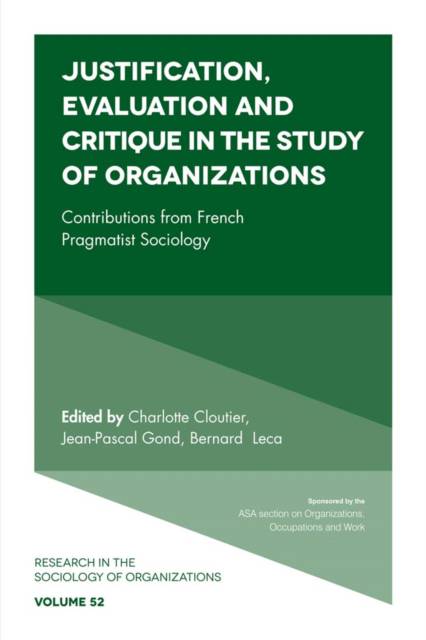
Justification, Evaluation and Critique in the Study of Organizations
Contributions from French Pragmatist Sociology
€ 288,45
+ 576 punten
Omschrijving
The papers included in the volume explore how mobilizing Boltanski and Thévenot's EW framework helps address questions regarding the premises and dynamics of agreement and disagreement in coordinated action, both within and across organizations, and by so doing, help advance our understanding of organizational processes more generally. The book is organized into four sections, each with contributions that address one of the four core theoretical objectives around which the volume is structured (1) to clarify how individuals manage the contradictions and compromises inherent to organizational pluralism; (2) to look at organizations critically by unpacking the roles of rhetoric and justification in the practice of critique; (3) to reconsider valuation and evaluation in organizations; and (4) to push the boundaries of the EW framework. These four objectives provide a scaffolding that helps further embed the framework in our contemporary thinking about organizations.
Specificaties
Betrokkenen
- Uitgeverij:
Inhoud
- Aantal bladzijden:
- 416
- Taal:
- Engels
- Reeks:
- Reeksnummer:
- nr. 52
Eigenschappen
- Productcode (EAN):
- 9781787143807
- Verschijningsdatum:
- 31/05/2017
- Uitvoering:
- Hardcover
- Formaat:
- Genaaid
- Afmetingen:
- 155 mm x 231 mm
- Gewicht:
- 716 g

Alleen bij Standaard Boekhandel
+ 576 punten op je klantenkaart van Standaard Boekhandel
AANGERADEN


Beoordelingen
We publiceren alleen reviews die voldoen aan de voorwaarden voor reviews. Bekijk onze voorwaarden voor reviews.