


- Afhalen na 1 uur in een winkel met voorraad
- Gratis thuislevering in België vanaf € 30
- Ruim aanbod met 7 miljoen producten
- Afhalen na 1 uur in een winkel met voorraad
- Gratis thuislevering in België vanaf € 30
- Ruim aanbod met 7 miljoen producten





Omschrijving
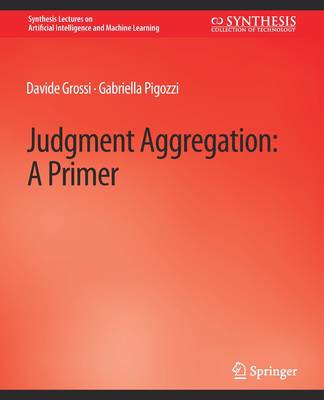
Judgment aggregation is a mathematical theory of collective decision-making. It concerns the methods whereby individual opinions about logically interconnected issues of interest can, or cannot, be aggregated into one collective stance. Aggregation problems have traditionally been of interest for disciplines like economics and the political sciences, as well as philosophy, where judgment aggregation itself originates from, but have recently captured the attention of disciplines like computer science, artificial intelligence and multi-agent systems. Judgment aggregation has emerged in the last decade as a unifying paradigm for the formalization and understanding of aggregation problems. Still, no comprehensive presentation of the theory is available to date. This Synthesis Lecture aims at filling this gap presenting the key motivations, results, abstractions and techniques underpinning it. Table of Contents: Preface / Acknowledgments / Logic Meets Social Choice Theory / Basic Concepts /Impossibility / Coping with Impossibility / Manipulability / Aggregation Rules / Deliberation / Bibliography / Authors' Biographies / Index
Specificaties
Betrokkenen
- Auteur(s):
- Uitgeverij:
Inhoud
- Aantal bladzijden:
- 133
- Taal:
- Engels
- Reeks:
Eigenschappen
- Productcode (EAN):
- 9783031004407
- Verschijningsdatum:
- 18/03/2014
- Uitvoering:
- Paperback
- Formaat:
- Trade paperback (VS)
- Afmetingen:
- 190 mm x 235 mm
- Gewicht:
- 272 g


Alleen bij Standaard Boekhandel
+ 75 punten op je klantenkaart van Standaard Boekhandel
Cadeau

AANGERADEN


Beoordelingen
We publiceren alleen reviews die voldoen aan de voorwaarden voor reviews. Bekijk onze voorwaarden voor reviews.