


- Afhalen na 1 uur in een winkel met voorraad
- Gratis thuislevering in België vanaf € 30
- Ruim aanbod met 7 miljoen producten
- Afhalen na 1 uur in een winkel met voorraad
- Gratis thuislevering in België vanaf € 30
- Ruim aanbod met 7 miljoen producten




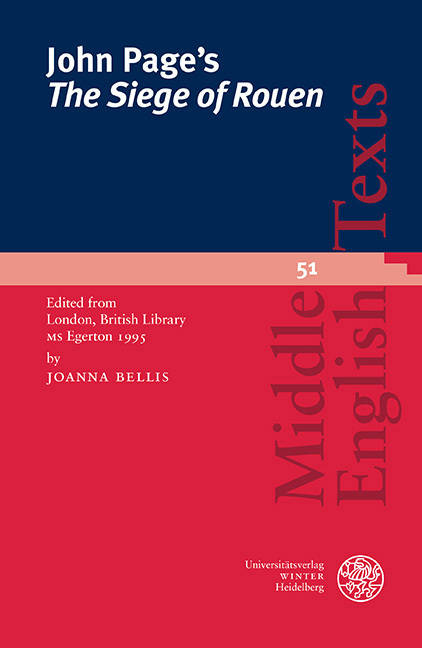
John Page's 'The Siege of Rouen'
Edited from London, British Library MS Egerton 1995
€ 93,45
+ 186 punten
Omschrijving
John Page's The Siege of Rouen is an eyewitness narrative account of Henry V's siege of Normandy's capital in 1418-19. The text is unique in English verse of the fifteenth century in providing a first-hand narrative of a significant event in contemporary warfare. The poet was (if we take him at his word) present at the siege, and his narration of the event is a complex mixture of patriotism and compassion, verse chronicle and historical romance. Page's poem is a rich and sophisticated piece of work, which until recently has received little critical interest. As a historical account it is highly valuable, containing many pieces of information not found elsewhere, and comparing favourably with other contemporary sources. Associated with the Middle English 'Brut' chronicle, it also sheds light on that text's process of composition and treatment of its source material. As a literary text it possesses a clarity of style, beauty of expression, and complexity of theme that merit much greater attention. This volume constitutes the first critical edition since Herbert Huscher's 'John Page's Siege of Rouen' published in 1927. It contains an introduction with descriptions of the fourteen manuscripts in which the text is known to survive complete or in fragments, discussions of historical context, authorship, language, metre and verse form, genre, literary background, and reception. The edition includes a full collation of the extant manuscripts in the textual notes and variants, a commentary, glossary, and index of personal and place names.
Specificaties
Betrokkenen
- Uitgeverij:
Inhoud
- Aantal bladzijden:
- 158
- Taal:
- Engels
- Reeks:
- Reeksnummer:
- nr. 51
Eigenschappen
- Productcode (EAN):
- 9783825364267
- Verschijningsdatum:
- 1/01/2015
- Uitvoering:
- Paperback
- Formaat:
- Trade paperback (VS)
- Afmetingen:
- 155 mm x 234 mm
- Gewicht:
- 362 g

Alleen bij Standaard Boekhandel
+ 186 punten op je klantenkaart van Standaard Boekhandel
CADEAU


Beoordelingen
We publiceren alleen reviews die voldoen aan de voorwaarden voor reviews. Bekijk onze voorwaarden voor reviews.