


- Afhalen na 1 uur in een winkel met voorraad
- Gratis thuislevering in België vanaf € 30
- Ruim aanbod met 7 miljoen producten
- Afhalen na 1 uur in een winkel met voorraad
- Gratis thuislevering in België vanaf € 30
- Ruim aanbod met 7 miljoen producten





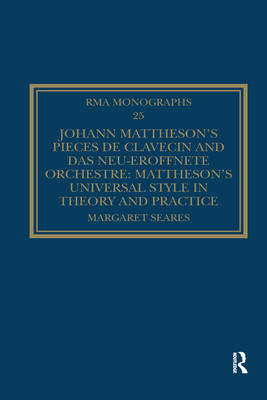
Johann Mattheson's Pièces de Clavecin and Das Neu-Eröffnete Orchestre
Mattheson's Universal Style in Theory and Practice
Margaret Seares
€ 94,95
+ 189 punten
Omschrijving
A prolific music theorist and critic as well as an established composer, Johannes Mattheson remains surprisingly understudied. In this important study, Margaret Seares places Mattheson's Pièces de clavecin (1714) in the context of his work as a public intellectual who encouraged German musicians and their musical public to eschew what he saw as the hidebound traditions of the past, and instead embrace a universalism of style and expression derived from contemporary currents in music of the leading European nations. Beginning with the early non-musical writings by Mattheson, Seares places them in the context of the cosmopolitan city-state of Hamburg, before moving to a detailed study of his first major musical treatise Das neu-eröffnete Orchestre of 1713, in which he espoused his views about the musics of the past and present and, in particular, the characteristics of the musics of Germany, Italy, France and England. This latter section of the treatise, Part III, is edited and translated into English in the book's appendix - the first such translation available. Seares then moves on to an evaluation of the Pièces de clavecin as a work in which Mattheson reflects in musical terms the themes of modernism (in the sense of à la mode) and universalism that are such a strong part of his writings of the period, and a work that represents an important precursor for the keyboard suites of Johann Sebastian Bach and Georg Frideric Handel.
Specificaties
Betrokkenen
- Auteur(s):
- Uitgeverij:
Inhoud
- Aantal bladzijden:
- 136
- Taal:
- Engels
- Reeks:
Eigenschappen
- Productcode (EAN):
- 9780367669300
- Verschijningsdatum:
- 30/09/2020
- Uitvoering:
- Paperback
- Formaat:
- Trade paperback (VS)
- Afmetingen:
- 156 mm x 234 mm
- Gewicht:
- 199 g


Alleen bij Standaard Boekhandel
+ 189 punten op je klantenkaart van Standaard Boekhandel
Cadeau

AANGERADEN


Beoordelingen
We publiceren alleen reviews die voldoen aan de voorwaarden voor reviews. Bekijk onze voorwaarden voor reviews.