


- Afhalen na 1 uur in een winkel met voorraad
- Gratis thuislevering in België vanaf € 30
- Ruim aanbod met 7 miljoen producten
- Afhalen na 1 uur in een winkel met voorraad
- Gratis thuislevering in België vanaf € 30
- Ruim aanbod met 7 miljoen producten





€ 79,45
+ 158 punten
Omschrijving
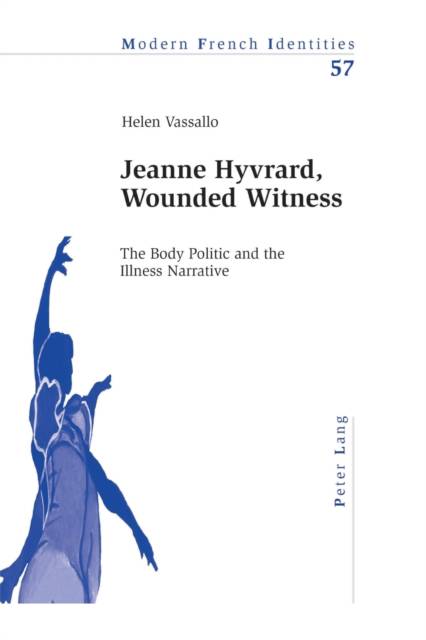
Critical responses to Jeanne Hyvrard have generally categorised her as a writer of 'écriture féminine' and/or autobiography, due to salient features of her oeuvre such as the use of first-person narrative, a cyclic writing style, and the quest for a 'female' language. Within these broader considerations, however, a recurrent motif throughout Hyvrard's writing is that of the body, specifically the female body, represented as suffering from different forms of physical/mental illness and emotional/social malaise. It is this primordial aspect of Hyvrard's work, on which surprisingly little critical analysis has been written, that this monograph explores.
It has been demonstrated that Hyvrard's works can be studied as a unity as well as individually, given that all of her texts form part of her wider theory. While this theory is often referred to in abstract terms as 'pensée ronde', 'pensée globale' or 'pensée-femme', this study shows that it can be more specifically highlighted as a theory of dis(-)ease (i.e. the intertwining of physical malady and social malaise, medical terms and metaphor), and, particularly, as a social theory of the dis(-)eased female body.
It has been demonstrated that Hyvrard's works can be studied as a unity as well as individually, given that all of her texts form part of her wider theory. While this theory is often referred to in abstract terms as 'pensée ronde', 'pensée globale' or 'pensée-femme', this study shows that it can be more specifically highlighted as a theory of dis(-)ease (i.e. the intertwining of physical malady and social malaise, medical terms and metaphor), and, particularly, as a social theory of the dis(-)eased female body.
Specificaties
Betrokkenen
- Auteur(s):
- Uitgeverij:
Inhoud
- Aantal bladzijden:
- 250
- Taal:
- Engels
- Reeks:
- Reeksnummer:
- nr. 57
Eigenschappen
- Productcode (EAN):
- 9783039110179
- Verschijningsdatum:
- 2/05/2007
- Uitvoering:
- Paperback
- Formaat:
- Trade paperback (VS)
- Afmetingen:
- 152 mm x 229 mm
- Gewicht:
- 340 g


Alleen bij Standaard Boekhandel
+ 158 punten op je klantenkaart van Standaard Boekhandel
Cadeau

AANGERADEN


Beoordelingen
We publiceren alleen reviews die voldoen aan de voorwaarden voor reviews. Bekijk onze voorwaarden voor reviews.