


Bedankt voor het vertrouwen het afgelopen jaar! Om jou te bedanken bieden we GRATIS verzending (in België) aan op alles gedurende de hele maand januari.
- Afhalen na 1 uur in een winkel met voorraad
- In januari gratis thuislevering in België
- Ruim aanbod met 7 miljoen producten
Bedankt voor het vertrouwen het afgelopen jaar! Om jou te bedanken bieden we GRATIS verzending (in België) aan op alles gedurende de hele maand januari.
- Afhalen na 1 uur in een winkel met voorraad
- In januari gratis thuislevering in België
- Ruim aanbod met 7 miljoen producten





€ 139,95
+ 279 punten
Omschrijving
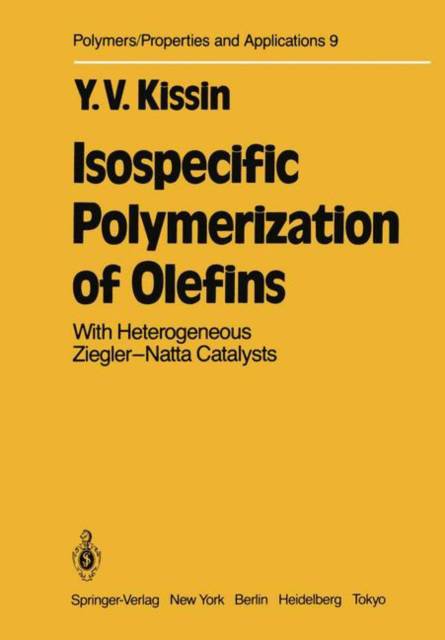
The discoveries of organometallic catalysts for olefin polymerization by Karl Ziegler and that of stereoregular olefin polymers by Giulio Natta are probably the two most important achievements in the areas of catalysis and polymer chemistry in the second half of this century. They led to the development of a new branch of chemical industry, and to a large volume production of high-density and linear low-density polyethylene, isotactic polypropylene, ethylene-propylene rubbers, isotactic poly- I-butene, and poly-4-methyl-l-pentene. These discoveries merited the Nobel prize, which was awarded to K. Ziegler and G. Natta in 1963. The initial works of Ziegler and Natta were followed by an "explosion" of scientific papers and patents covering all aspects of polymerization chemistry, catalyst synthesis, and polymerization kinetics as well as the structural, chemical, physical, and technological characteristics of stereo regular polyolefins, polydienes, and olefin copolymers. It is sufficient to say that in the twenty-five years after the first publications more than 15,000 papers and patents appeared on subjects related to the area. . The development brought about the establishment of several prominent groups of scientists occupied with the study of olefin polymerization. The most important of these were scientific schools in Italy, Germany, England, the United States, Japan, the Soviet Union, Czechoslovakia, and Venezuela. In addition, many major chemical and petrochemical corporations throughout the world established labora- tories devoted to the development of the technology of catalyst synthesis and olefin polymerization.
Specificaties
Betrokkenen
- Auteur(s):
- Uitgeverij:
Inhoud
- Aantal bladzijden:
- 439
- Taal:
- Engels
- Reeks:
- Reeksnummer:
- nr. 9
Eigenschappen
- Productcode (EAN):
- 9781461295563
- Verschijningsdatum:
- 27/09/2011
- Uitvoering:
- Paperback
- Formaat:
- Trade paperback (VS)
- Afmetingen:
- 178 mm x 254 mm
- Gewicht:
- 784 g


Alleen bij Standaard Boekhandel
+ 279 punten op je klantenkaart van Standaard Boekhandel
SOLDEN


Beoordelingen
We publiceren alleen reviews die voldoen aan de voorwaarden voor reviews. Bekijk onze voorwaarden voor reviews.