


- Afhalen na 1 uur in een winkel met voorraad
- Gratis thuislevering in België vanaf € 30
- Ruim aanbod met 7 miljoen producten
- Afhalen na 1 uur in een winkel met voorraad
- Gratis thuislevering in België vanaf € 30
- Ruim aanbod met 7 miljoen producten





€ 4,49
+ 4 punten
Omschrijving
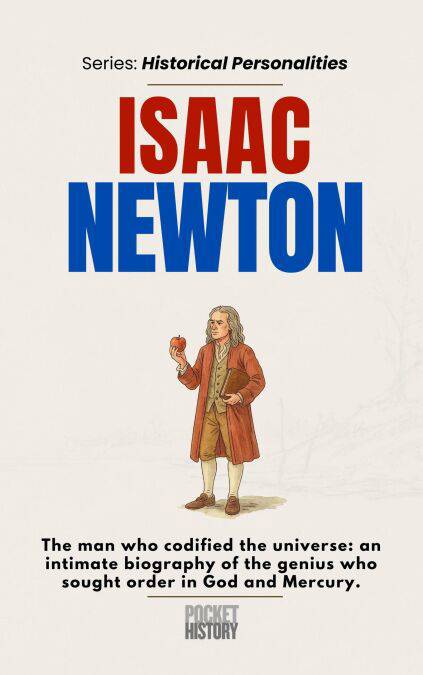
Isaac Newton is widely regarded as one of the greatest scientific minds in history. His discoveries laid the foundation for modern physics and mathematics, transforming humanity's understanding of the universe. From the laws of motion to the theory of universal gravitation, Newton's work continues to influence science centuries after his time.
Born in England in 1643, Newton showed extraordinary intellectual ability from a young age. During a period of isolation caused by the Great Plague, he developed many of his most important ideas, including calculus and his groundbreaking insights into light and optics. His experiments with prisms revealed the true nature of light and color, forever changing the field of optics.
Newton's most famous work, Philosophiæ Naturalis Principia Mathematica, introduced the laws of motion and the law of universal gravitation. These principles explained how objects move both on Earth and in the cosmos, unifying the mechanics of the heavens and the physical world.
This book explores Newton's life, his revolutionary discoveries, and the lasting impact of his work on science, technology, and human knowledge. It reveals the story of a brilliant yet complex man whose curiosity and determination reshaped the world.
Perfect for readers interested in science, mathematics, and the life of one of history's most influential thinkers.
Specificaties
Betrokkenen
- Auteur(s):
- Uitgeverij:
Inhoud
- Taal:
- Engels
- Reeks:
Eigenschappen
- Productcode (EAN):
- 9798233695223
- Verschijningsdatum:
- 16/03/2026
- Uitvoering:
- E-book
- Formaat:
- ePub


Alleen bij Standaard Boekhandel
+ 4 punten op je klantenkaart van Standaard Boekhandel
Cadeau

AANGERADEN


Beoordelingen
We publiceren alleen reviews die voldoen aan de voorwaarden voor reviews. Bekijk onze voorwaarden voor reviews.