


- Afhalen na 1 uur in een winkel met voorraad
- Gratis thuislevering in België vanaf € 30
- Ruim aanbod met 7 miljoen producten
- Afhalen na 1 uur in een winkel met voorraad
- Gratis thuislevering in België vanaf € 30
- Ruim aanbod met 7 miljoen producten





€ 109,95
+ 219 punten
Omschrijving
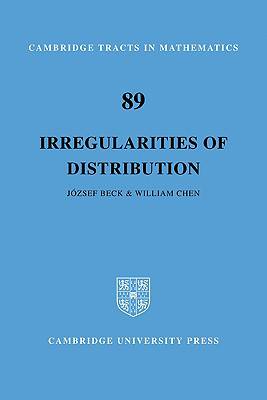
This book is an authoritative description of the various approaches to and methods in the theory of irregularities of distribution. The subject is primarily concerned with number theory, but also borders on combinatorics and probability theory. The work is in three parts. The first is concerned with the classical problem, complemented where appropriate with more recent results. In the second part, the authors study generalizations of the classical problem, pioneered by Schmidt. Here, they include chapters on the integral equation method of Schmidt and the more recent Fourier transform technique. The final part is devoted to Roth's '1/4-theorem'.
Specificaties
Betrokkenen
- Auteur(s):
- Uitgeverij:
Inhoud
- Aantal bladzijden:
- 312
- Taal:
- Engels
- Reeks:
- Reeksnummer:
- nr. 89
Eigenschappen
- Productcode (EAN):
- 9780521093002
- Verschijningsdatum:
- 8/01/2009
- Uitvoering:
- Paperback
- Formaat:
- Trade paperback (VS)
- Afmetingen:
- 152 mm x 229 mm
- Gewicht:
- 458 g


Alleen bij Standaard Boekhandel
+ 219 punten op je klantenkaart van Standaard Boekhandel
Cadeau

AANGERADEN


Beoordelingen
We publiceren alleen reviews die voldoen aan de voorwaarden voor reviews. Bekijk onze voorwaarden voor reviews.