


- Afhalen na 1 uur in een winkel met voorraad
- Gratis thuislevering in België vanaf € 30
- Ruim aanbod met 7 miljoen producten
- Afhalen na 1 uur in een winkel met voorraad
- Gratis thuislevering in België vanaf € 30
- Ruim aanbod met 7 miljoen producten





Omschrijving
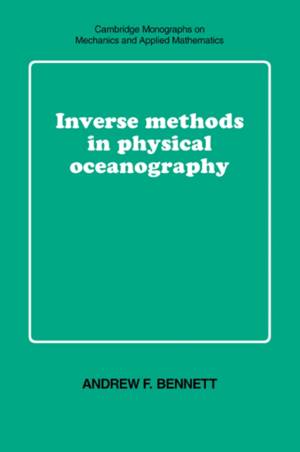
Professor Bennett's work explores the potential for inverse theory, emphasizing possibilities rather than expedient or rudimentary applications. In addition to interpolating the data and adding realism to the model solutions, the methods can yield estimates for unobserved flow variables, forcing fields, and model parameters. Inverse formulations can resolve ill-posed modeling problems, lead to design criteria for oceanic observing systems, and enable the testing of models as scientific hypothesis. Ocean models considered range from linear, finite-dimensional systems of equality and inequality constraints, to nonlinear, regional primitive-equation models. Examples from the recent oceanographic literature are analyzed, and several outstanding research problems are surveyed. The methods employ solution techniques including Kalman filters and smoothers, representer expansions and descent algorithms. Exercises of varying difficulty rehearse technical skills and supplement the central theoretical development.
Specificaties
Betrokkenen
- Auteur(s):
- Uitgeverij:
Inhoud
- Aantal bladzijden:
- 368
- Taal:
- Engels
- Reeks:
Eigenschappen
- Productcode (EAN):
- 9780521055284
- Verschijningsdatum:
- 21/01/2008
- Uitvoering:
- Paperback
- Formaat:
- Trade paperback (VS)
- Afmetingen:
- 152 mm x 229 mm
- Gewicht:
- 539 g


Alleen bij Standaard Boekhandel
+ 224 punten op je klantenkaart van Standaard Boekhandel
Cadeau

AANGERADEN


Beoordelingen
We publiceren alleen reviews die voldoen aan de voorwaarden voor reviews. Bekijk onze voorwaarden voor reviews.